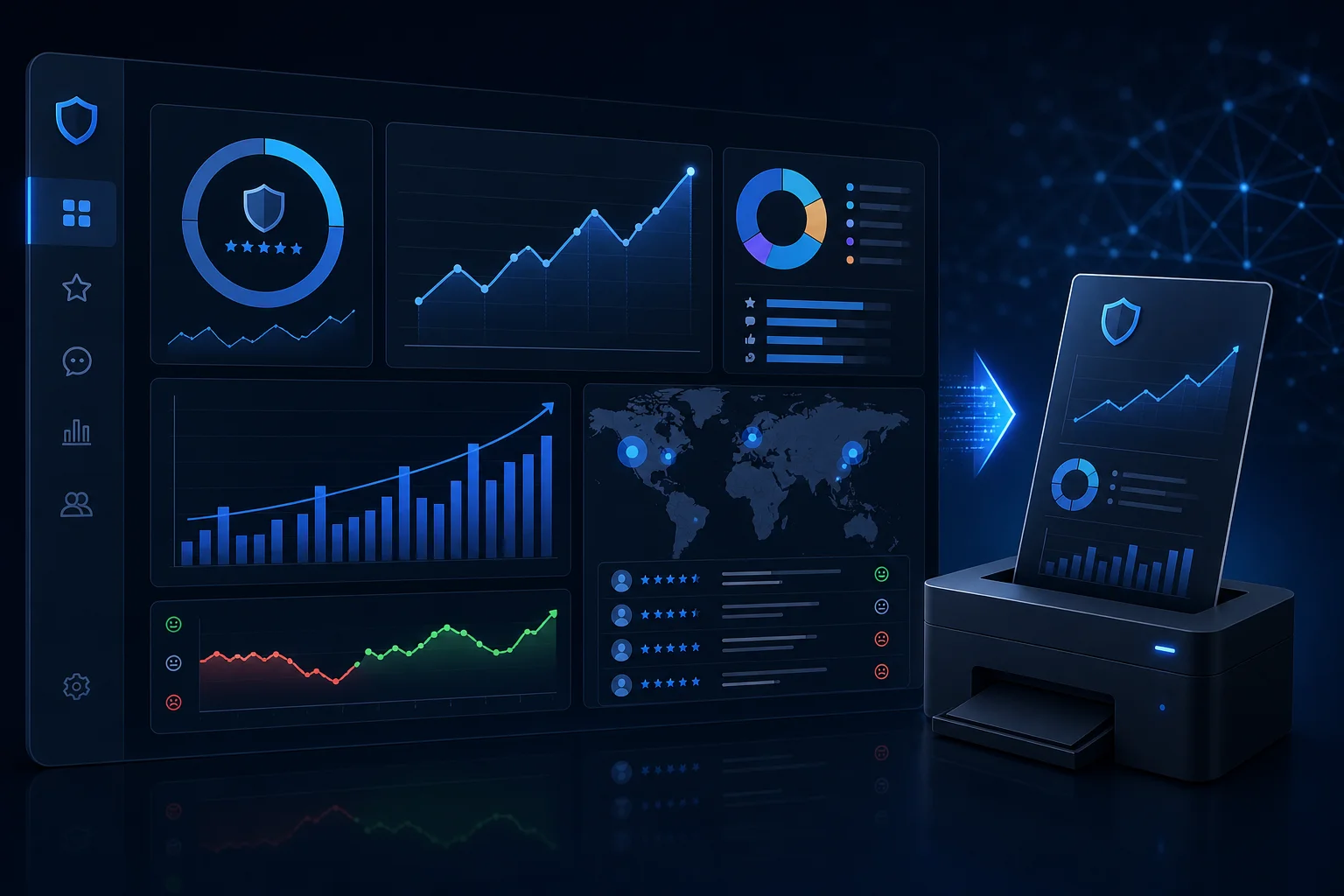
Turn reputation data into decisions, not just dashboards.
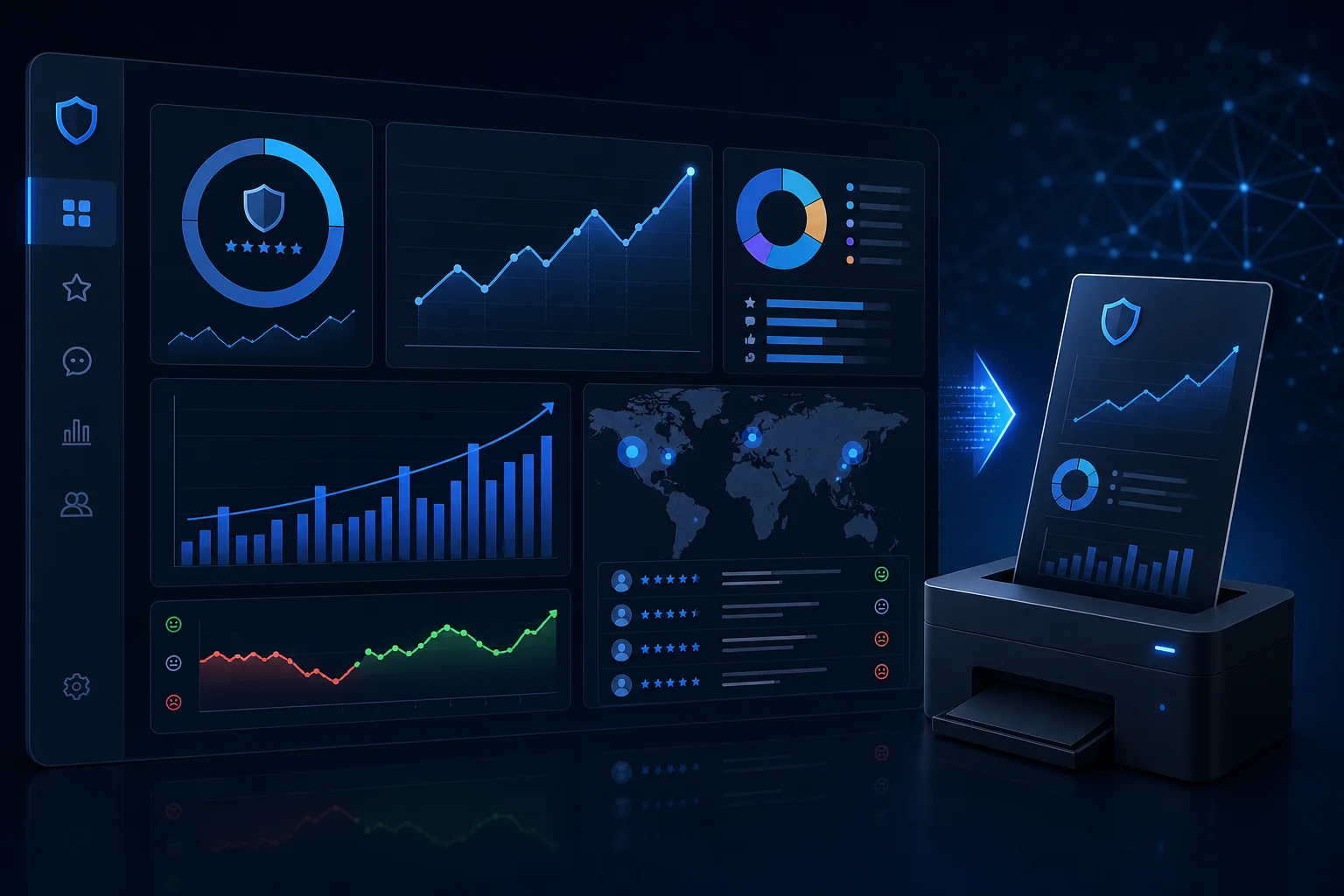
Reputation reporting services with automated executive dashboards, trend analytics, KPI tracking, competitive benchmarking, and multi-location reporting that connects reputation metrics to business outcomes.
Most reputation data sits in platform silos, gets pulled into manual spreadsheets once a quarter, and reaches leadership in a format nobody can act on. Internetzone I's reputation reporting services eliminate the manual labor, unify data from every platform, and deliver automated reports and dashboards to every stakeholder in the format they need to make decisions. Executive summaries for the board. Operational scorecards for location managers. Competitive benchmarks for the strategy team. All automated. All always current. All connected to the business outcomes that justify your reputation investment. Our reporting gives multi-location brands the insight needed to drive revenue through better customer feedback management.
Get a Free Reporting Assessment
We'll review your current reputation reporting and show you what a fully automated, multi-stakeholder reporting system would look like for your organization.
Our Approach to Reputation Reporting Services
Reputation reporting at most organizations is a broken process. Someone on the marketing team spends 6 to 10 hours a month logging into Google, Yelp, Facebook, BBB, and a handful of other platforms, copying data into a spreadsheet, making charts, writing commentary, and emailing a PDF to leadership. By the time the report arrives, the data is two weeks old. The commentary is generic because the person building the report isn't a reputation strategist. And the report answers 'what happened' without answering 'why it happened' or 'what we should do about it.' Our reputation reporting services replace this broken process with an automated, analytical, multi-stakeholder reporting system that eliminates manual labor, delivers always-current data, and provides the strategic interpretation that turns data into decisions.
Our approach has three pillars. First, automation: data ingestion, metric calculation, report generation, and distribution are all automated. Nobody on your team spends hours building reports. Reports build themselves on schedule and arrive in stakeholders' inboxes without human intervention. Second, stakeholder-specific design: every report is built for a specific stakeholder and a specific set of decisions. The CEO's report answers different questions than the regional manager's report, and they get different reports. Third, analytical depth: our reports don't just display data. They interpret it. Automated commentary explains what the numbers mean. Trend forecasts show where things are headed. Our strategy team adds human analysis that connects reputation metrics to business outcomes and competitive dynamics.
Reputation reporting integrates with every other reputation service. Pair it with Sentiment Analysis Services to add sentiment depth to your reports. Combine it with Competitor Monitoring Services for competitive benchmarking in every report. Use it with Review Platform Coverage Services to add platform-specific performance metrics. Or make reporting the analytical backbone of our full Reputation Management program.
Why Brands Choose Our Online Reputation Reporting
Automated, analytical, multi-stakeholder reporting that eliminates manual labor and connects reputation to business outcomes.
Reports that write themselves, automatically
The biggest complaint we hear about reputation reporting is the manual labor. Someone spends 6 hours a month building reports that are already out of date by distribution time. Our automated reporting eliminates 100 percent of that labor. Configure once, receive forever.
Dashboards designed for decisions, not just data display
Most reputation dashboards are data firehoses: dozens of charts, hundreds of numbers, no narrative. Our executive reporting is built to answer the three questions leadership actually asks: what happened, why did it happen, and what should we do about it?
KPIs tied to business outcomes, not vanity metrics
Review count is a vanity metric. Review count correlated with local search conversion rate is a business metric. Our KPI framework connects every reputation metric to the business outcome it drives, so reporting justifies investment instead of just documenting activity.
Visibility for every stakeholder at every level
The CEO needs a one-page summary. The regional VP needs divisional comparisons. The store manager needs a weekly scorecard. One-size-fits-all reporting serves nobody well. Our multi-level reporting architecture gives every stakeholder exactly their view.
Trend forecasts that give you lead time to act
Historical reports tell you what already happened. Trend forecasts project where current trajectories lead in 30, 60, and 90 days. That lead time is the difference between proactively fixing a problem and reactively explaining a decline in the quarterly review.
Board-ready reports that demonstrate reputation ROI
Reputation is often treated as a soft discipline because it's hard to report on rigorously. Our executive reporting changes that. Clear metrics, trend data, competitive benchmarks, and outcome correlation give reputation the same analytical rigor as any other business function.
Complete Reputation Management Reporting & Analytics Tools
From executive reputation dashboards to automated reporting to multi-location analytics, every reporting capability in one integrated platform.
Executive Reputation Dashboards
Board meetings and quarterly business reviews demand reputation data that's clear, credible, and tied to business outcomes. Our reputation reporting services include purpose-built executive dashboards designed for the C-suite and board audience, not for reputation practitioners. The executive dashboard surfaces the metrics leadership actually cares about: overall brand reputation score (a composite of rating, sentiment, response rate, and competitive position), month-over-month and year-over-year trend lines, reputation performance by business unit and region, correlation between reputation metrics and revenue or customer retention data, top reputation risks and opportunities, and competitive reputation positioning versus named competitors. Every metric is presented in context with benchmarks, trend arrows, and plain-English commentary that explains what the numbers mean and why they matter. The dashboard supports one-click export to PDF for board decks and investor presentations. It updates automatically with live data so the numbers in the board deck are always current, not stale data pulled manually two weeks before the meeting. For enterprise brands, the dashboard supports role-based views so the CEO sees the enterprise summary while division presidents see their division's performance and regional directors see their markets.
Trend Analysis & Performance Tracking
Point-in-time metrics are snapshots. Trends are stories. Our reputation reporting services include longitudinal trend analysis that tracks every reputation metric over time: rating trends by platform and by location, review volume and velocity trends, sentiment trends by aspect and by keyword, response rate and response time trends, competitive positioning trends, and brand mention volume and sentiment trends across social and news sources. The trend analysis module automatically detects statistically significant shifts and annotates them with context: a sudden review velocity spike is flagged with whether it's organic or likely campaign-driven, a sentiment decline is cross-referenced with operational events that might explain it, a competitive ranking drop is paired with analysis of what the gaining competitor did differently. Trend forecasts project current trajectories forward 30, 60, and 90 days using time-series modeling, giving leadership lead time to address emerging problems before they impact the metrics that show up in the next quarterly review. Weekly trend snapshots are delivered automatically to configured stakeholders, and any stakeholder can drill down from the enterprise trend view to the individual review or mention that's driving the trend.
Automated Reputation Reporting
Manual reporting is the biggest time-waste in reputation management. Someone on your team spends hours each week or month logging into multiple platforms, copying data into spreadsheets, formatting charts, and writing commentary. It's slow, error-prone, and the report is already out of date by the time it's distributed. Our reputation reporting services eliminate manual reporting entirely. The platform automatically generates and distributes reports on whatever cadence you define: daily operational reports (review volume, alerts triggered, response time compliance), weekly performance snapshots (trends, anomalies, key metrics by location), monthly executive summaries (comprehensive reputation performance with analysis and recommendations), and quarterly board-ready reports (strategic reputation assessment with competitive benchmarking and ROI analysis). Reports are delivered as PDF attachments via email, published to shared dashboards, pushed to Slack or Teams channels, or exported directly to PowerPoint and Google Slides for presentations. Every report is fully branded with your company's logo and color scheme. Report content, format, and distribution are configured once and run automatically thereafter. The reporting engine pulls data from every connected platform in real time, so reports reflect current data, not data that was current when someone started building the report two weeks ago.
Multi-Location & Multi-Brand Reporting
For franchise systems, retail chains, healthcare groups, and holding companies with multiple brands, reporting complexity scales exponentially with each additional location or brand. A 200-location brand doesn't need one reputation report. It needs a hierarchy of reports: a one-page enterprise summary for the CEO, divisional reports for regional VPs, location-level scorecards for general managers, and a competitive benchmarking report for the strategy team. Our reputation reporting services include a multi-entity reporting architecture that handles this complexity natively. The platform maintains separate reporting profiles for each entity (brand, division, region, location) with role-based access so every stakeholder sees exactly the reports that matter to them and nothing they don't need. The reporting hierarchy rolls up location data to regions, regions to divisions, divisions to enterprise, with consistent metrics and formatting at every level. Performance rankings within peer groups (all Southeast locations, all locations with revenue over $5M, all pediatric dental locations) add internal benchmarking that drives accountability and surfaces best practices. When a location in Dallas is outperforming every other location on review response time, that shows up in every regional manager's report as a benchmark, and the practices driving that performance become a template for other locations to follow.
KPI Definition & Goal Tracking
Reputation reporting is only valuable if it measures what matters to your business. A generic dashboard showing review count and average rating is better than nothing, but it doesn't connect reputation metrics to business outcomes or hold teams accountable to specific goals. Our reputation reporting services include a structured KPI definition and goal-tracking framework. We work with your leadership team to define the reputation KPIs that align with your business objectives: not just 'improve our Google rating' but 'increase Google rating from 4.2 to 4.5 by Q2 to support a 15 percent improvement in local search conversion rate.' Not just 'respond to more reviews' but 'achieve 95 percent response rate within 4 hours across all platforms, with 100 percent response rate on negative reviews within 1 hour.' The platform tracks every KPI against its target, displays progress with visual goal gauges, and automatically alerts stakeholders when a KPI is trending off-track. Quarterly KPI reviews with our strategy team evaluate progress, adjust targets based on market changes and competitive dynamics, and define new KPIs as business priorities evolve. This framework ensures reputation reporting isn't just informative. It's accountable to measurable outcomes that your leadership team has defined as important.
Custom Report Building & Data Export
Pre-built dashboards and reports cover 90 percent of what most teams need, but every organization has unique reporting requirements. A marketing team might need a report that combines reputation data with campaign performance metrics. An operations team might need a report that correlates review sentiment by location with operational KPIs like ticket volume or revenue per location. A franchise development team might need a report on franchisee reputation performance for franchise sales presentations. Our reputation reporting services include a custom report builder that lets your team create reports combining any metrics from the reputation platform with data from external sources (your CRM, your BI tool, your operational systems) via API integration. Custom reports can include your proprietary metrics, your specific grouping and filtering logic, and your brand's unique visual identity. For teams that prefer to work with raw data in their own analytics environment, the platform provides comprehensive data export: scheduled CSV and JSON exports to cloud storage (Google Cloud Storage, AWS S3, Azure Blob), direct connections to BI tools (Tableau, Power BI, Looker, Domo), and a REST API for programmatic access. The data export infrastructure supports full historical data as well as incremental daily updates, so your data warehouse always has a complete and current reputation dataset to combine with your other business data.
Our process
How We Build Your Business Reputation Reporting
Four phases from KPI discovery to a fully automated, multi-stakeholder reporting system that evolves with your business.
- 1
Reporting Discovery & KPI Design
We map your stakeholder landscape (who needs what reports, on what cadence, to make what decisions) and define the KPIs that connect reputation metrics to your business objectives. This discovery phase produces a complete reporting blueprint: dashboards, reports, KPIs, goals, and distribution.
- 2
Dashboard & Report Configuration
Our team builds every dashboard and report in the platform, configured to your specifications. Data sources are connected, metrics are defined, visualizations are designed, report templates are created, distribution schedules are set, and access controls are configured for every stakeholder group.
- 3
Launch, Train & Iterate
Dashboards and reports go live. We train every stakeholder group on how to read and act on their reports. The first 30 days include weekly check-ins to refine reports based on actual usage: what's getting used, what's being ignored, what questions reports aren't answering yet.
- 4
Continuous Reporting & Quarterly Strategy Reviews
Automated reporting runs on schedule. Quarterly strategy reviews with our team evaluate KPI progress, adjust targets, refine report content, and incorporate new data sources. The reporting system evolves as your business, your competitive landscape, and your reputation strategy evolve.
Why Online Reputation Reporting Drives Revenue
How reputation reporting tools turn customer feedback into actionable insight that improves the customer experience and grows your brand.
How Reporting Turns Customer Feedback Into Business Insight
Online reputation reporting transforms raw reviews and feedback from customers into structured insight that leadership can act on. When customers leave reviews across online platforms, social media, and surveys, the volume of feedback quickly exceeds what any team can process manually. Our reporting tools consolidate reviews from every online source, apply sentiment analysis to customer feedback, and surface the insight that matters most: what customers love, what frustrates them, and where the focus of improvement should be. For multi-location brands, this means understanding how customers at each location feel compared to consumers at other locations and across the industry. The integration of feedback from surveys, reviews, and social listening into a single reporting platform gives your brand a complete picture of customer feedback across every touchpoint. Unlike tools like Sprout Social that focus on social media alone, our approach combines review management data, business listings performance, surveys, and social listening into unified reports that show the full online reputation picture. This integration of data sources means your brand can track how customers and consumers perceive your business across every media channel, turning scattered feedback into the insight that helps drive revenue.
How Reputation Reporting Supports SEO and Business Growth
Reputation reporting and SEO are more connected than most brands realize. Reviews impact local SEO rankings directly—search engines factor online reviews into local search results, and customers increasingly use reviews as their primary research tool before making purchase decisions. Our reporting tools track SEO impact alongside reputation metrics: how reviews affect local SEO visibility, how business listings accuracy impacts search rankings, and how customer feedback trends correlate with online traffic and conversion rates. For brands managing business listings across dozens of directories and review platforms, reporting provides the insight to focus resources where they drive revenue most efficiently. Multi-location brands especially benefit from the integration of SEO and reputation data: seeing which locations' online reviews are helping or hurting local SEO performance. The media and social media monitoring components add insight into how consumers discuss your brand across the broader online landscape. Surveys and direct feedback tools capture the voice of customers who might not leave public reviews. All of this integration means your brand gets a complete, data-driven understanding of online reputation that SEO teams, marketing leaders, and operations executives can all use to drive revenue and improve the customer experience. In an industry where consumers trust online reviews as much as personal recommendations, having clear reporting on what customers are saying—and what insight to extract from it—isn't optional. It's how the best brands stay ahead.