Know how customers feel, not just what they rate.
NLP-powered sentiment analysis services that classify, track, and forecast customer sentiment across reviews, social media, support tickets, and surveys, with real-time alerts and executive dashboards.
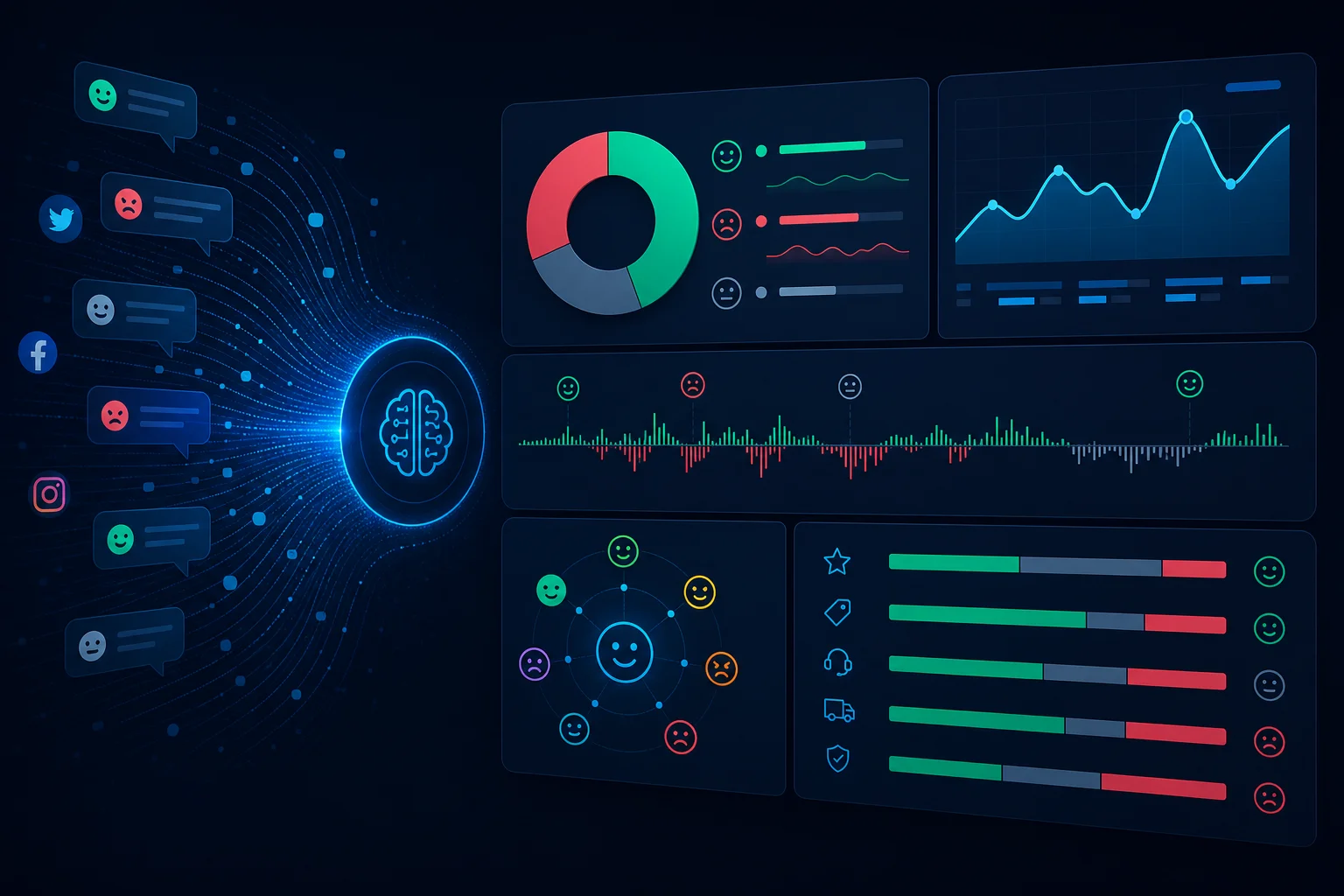
A 4.2 star average hides more than it reveals. Internetzone I's sentiment analysis services read every word your customers write, scoring sentiment by aspect (service, quality, price, speed) across every channel where they talk about you. Real-time alerts route negative sentiment to the right team in seconds. Trend forecasts tell you where sentiment is headed before it gets there. And multi-location dashboards benchmark every site against every other site so you know exactly where to focus. This is customer sentiment tracking that drives operations, not just reports.
Get a Free Sentiment Audit
We'll analyze your last 500 reviews and show you exactly what sentiment trends are hiding in your star ratings, with an aspect-level breakdown.
Our Approach to Sentiment Analysis Services
Most reputation tools reduce sentiment to a number: a percentage positive, a color-coded dashboard, a smiley-face emoji next to each review. That's sentiment reporting. It's not sentiment analysis. Our sentiment analysis services start from a fundamentally different premise: the goal isn't to know your sentiment score. The goal is to know which specific things customers love and hate, at which specific locations, trending in which direction, so you can make specific operational changes that improve customer experience and revenue. That's the difference between a dashboard and a decision-support system.
We build custom NLP models on your customer data because generic models fail on industry-specific language. A model trained on movie reviews doesn't know that 'the crown came off after two weeks' is a serious negative for a dental practice. Our models learn your customers' vocabulary and your industry's sentiment signals. Aspect-based analysis then breaks every feedback item into the specific things customers mention (staff, pricing, wait time, quality, cleanliness) and scores each independently. The result is a customer sentiment tracking system that tells you not just that sentiment is down 3 percent, but that sentiment on wait times at your four Florida locations specifically is down 3 percent, driven primarily by a staffing shortage at two of them during the dinner rush. That's actionable. That's the difference our approach makes.
Sentiment analysis powers every other reputation service we offer. Pair it with Competitor Monitoring Services to benchmark your sentiment against competitors. Combine it with Reputation Reporting Services for comprehensive executive dashboards. Or use it alongside our full Reputation Management program for complete monitoring, response, and generation.
Why Brands Choose Our Sentiment Analysis Tools & Services
Custom-trained NLP, aspect-level analysis, real-time alerting, and forecasting that turns sentiment data into operational action.
Custom-trained NLP that actually understands your customers
Generic sentiment tools use one-size-fits-all models trained on movie reviews and product descriptions. Our sentiment analysis services train models on your actual customer language, learning the slang, jargon, and context-specific sentiment signals that make analysis accurate for your business.
Aspect-level insight instead of surface-level scores
A 4.2 average rating tells you nothing about what's actually happening. Aspect-based sentiment breaks every piece of feedback into specific dimensions (service, quality, price, speed, cleanliness) so you know exactly what's driving the number and where to focus improvement.
Operational speed from real-time alerting
Sentiment data that arrives in a monthly report is interesting. Sentiment data that fires a Slack alert to the store manager 90 seconds after a negative review posts is operational. Real-time routing means the right person acts while the customer still cares.
Forward-looking forecasts, not just backward reports
Traditional sentiment reporting shows you what already happened. Our forecasting models project sentiment 30, 60, and 90 days forward based on current trajectories, giving you lead time to intervene before a declining trend becomes a reputation crisis.
Full-spectrum coverage beyond just reviews
Reviews tell part of the story. Social comments, forum threads, TikTok discussions, and news mentions tell the rest. Our sentiment analysis covers every channel where customers talk about your brand, not just the ones with star ratings.
Multi-location benchmarking and accountability
For brands with 10, 50, or 500 locations, sentiment data becomes a management tool. Rank locations by sentiment score, by aspect, by trend direction. Identify your best and worst performers. Tie sentiment KPIs to manager performance reviews and bonus structures.
Complete Machine Learning & Sentiment Analysis Capabilities
From NLP sentiment analysis and machine learning models to aspect-based sentiment analysis, emotional detection, and real-time sentiment alerts, every capability in one integrated platform that delivers actionable insights into customer emotions.
NLP-Powered Sentiment Analysis Engine
Our sentiment analysis services are built on a proprietary natural language processing engine trained specifically on customer feedback data from reviews, social media comments, support tickets, and survey responses. Unlike generic NLP tools that stumble on sarcasm, industry jargon, and mixed sentiment (a review praising the product but complaining about the wait time), our models are fine-tuned across your industry and your specific customer language patterns. The system classifies every piece of feedback as positive, negative, or neutral, then assigns a confidence-weighted sentiment score on a scale of 1 to 100. We continuously retrain the models on your data so accuracy improves month over month. What starts at roughly 85 percent accuracy on mixed-sentiment content typically reaches 93 percent or higher within the first quarter as the system learns your customers' vocabulary, tone patterns, and the specific things they care about and complain about. This isn't a one-size-fits-all sentiment API. It's a custom-trained engine that gets smarter the longer it runs on your data.
Aspect-Based Sentiment Analysis
A single five-star review can hide a serious problem. 'Love the food but the service was terrible' reads as positive to a basic sentiment tool that only looks at the star rating or the overall review score. Our aspect-based sentiment analysis services break every piece of feedback down into granular categories: product quality, staff friendliness, wait times, pricing perception, cleanliness, ease of use, delivery speed, support responsiveness, and any custom aspects you define. Each aspect gets its own independent sentiment score, so you can see that product sentiment is trending up while service sentiment is quietly declining across three locations. This granular view is what turns sentiment analysis from a vanity metric into an operational tool. Regional managers use it to spot training gaps. Product teams use it to validate feature launches. Customer success teams use it to identify at-risk accounts before they churn. Aspect-based sentiment gives you the 'why' behind the 'what,' and that's where the real business value lives.
Sentiment Trend Tracking & Forecasting
Point-in-time sentiment scores are interesting. Sentiment trends are actionable. Our sentiment analysis services include longitudinal tracking that plots sentiment by keyword, by aspect, by location, and by customer segment over days, weeks, months, and quarters. The dashboard surfaces statistically significant shifts: a two-point drop in 'staff friendliness' sentiment across your Southeast region over three weeks is flagged automatically before it becomes a five-point drop and a wave of one-star reviews. Beyond backward-looking trends, the system generates forward-looking sentiment forecasts using time-series modeling. If current trajectory holds, where will sentiment be in 30, 60, and 90 days? These projections let you get ahead of problems instead of reacting to them. For multi-location brands especially, trend data at the individual location level lets you benchmark locations against each other, identify which general managers are driving sentiment improvement and which are presiding over decline, and allocate training and operational resources where they'll have the biggest impact on customer sentiment.
Real-Time Sentiment Alerts & Escalation
Sentiment analysis is only as valuable as the speed at which it reaches the right person. Our platform monitors every incoming piece of customer feedback in real time and triggers alerts based on configurable sentiment thresholds. A support ticket with a sentiment score below 30 fires an immediate escalation to the customer success team lead. A review mentioning 'lawsuit' or 'fraud' with negative sentiment triggers an alert to legal and PR simultaneously. A cluster of negative-sentiment reviews hitting three or more locations in the same region within a 24-hour window fires a regional anomaly alert that suggests a systemic issue rather than isolated incidents. Alerts route through email, SMS, Slack, Teams, or directly into your CRM and helpdesk via API. Each alert includes the full text of the feedback, the sentiment score breakdown by aspect, the customer's history, and a recommended response template. Response time SLAs are tracked and reported weekly, so you know sentiment-sensitive issues aren't sitting in an inbox while the customer's frustration compounds.
Social Media & Mention Sentiment Monitoring
Reviews are the most structured form of customer feedback, but they're far from the only form. Our sentiment analysis services extend beyond review platforms to cover social media comments, Reddit threads, X (Twitter) mentions, TikTok comments, forum discussions, blog comments, and news article mentions. The social listening module captures unstructured brand mentions across the open web and applies the same NLP sentiment scoring, aspect classification, and trend tracking that we apply to structured reviews. A viral TikTok about a bad experience at your restaurant that's generating thousands of comments would be invisible to a review-only monitoring tool. Our system catches it within minutes and surfaces the dominant sentiment themes in the comment thread. This gives you a complete picture of how people feel about your brand everywhere they're talking about it, not just on the platforms that happen to have a star-rating system.
Executive Sentiment Dashboards & Reporting
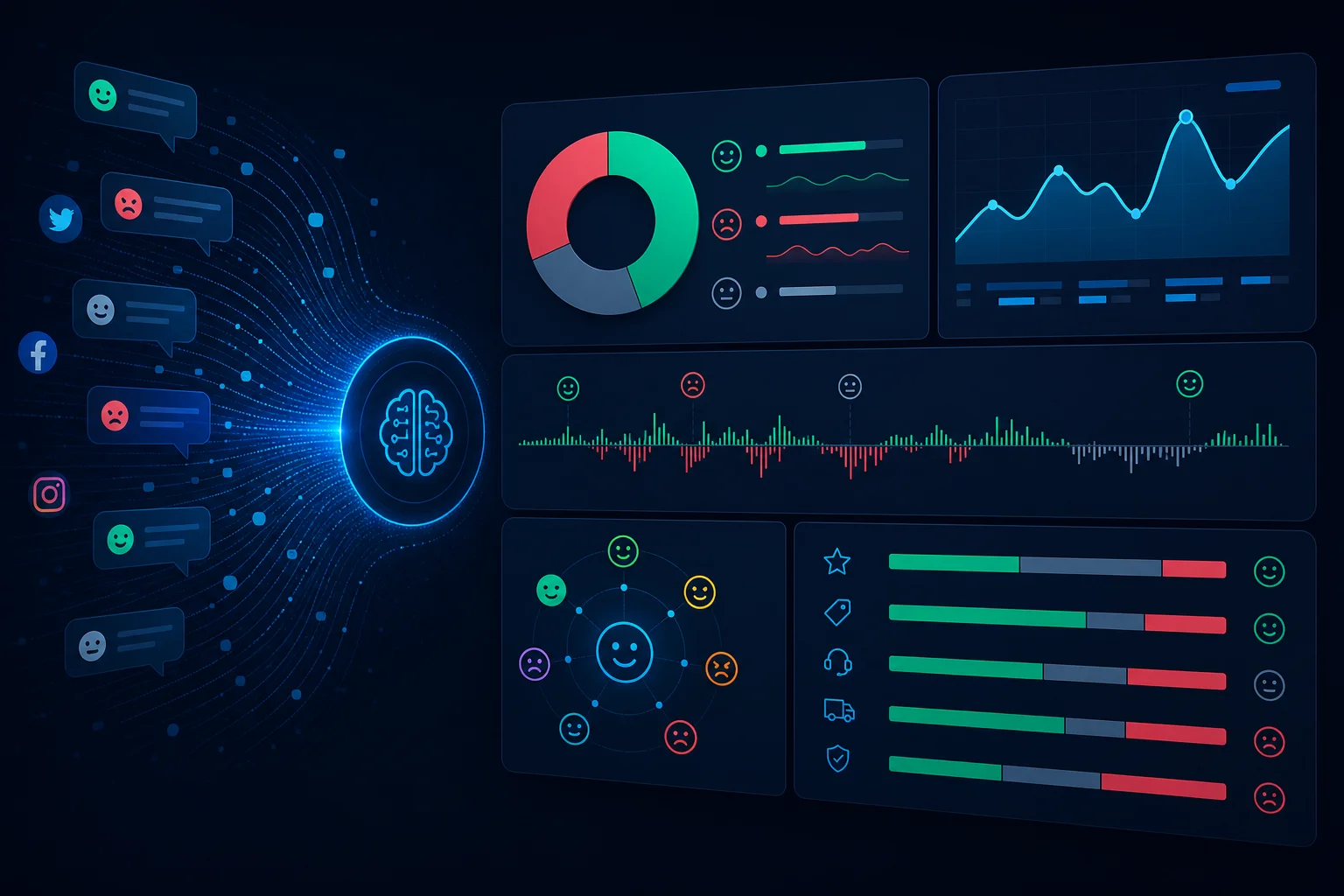
Raw sentiment data is overwhelming. Our sentiment analysis services include purpose-built executive dashboards that translate millions of data points into clear, decision-ready visualizations. The C-suite dashboard shows overall brand sentiment score, sentiment by business unit, sentiment by region, month-over-month change, and top five sentiment drivers (both positive and negative). The marketing dashboard shows campaign sentiment lift, competitive sentiment positioning, and channel-specific sentiment trends. The operations dashboard shows location-level sentiment rankings, aspect-level performance scores (staff, cleanliness, wait time, quality), and correlation with operational metrics like revenue per location and customer retention. Every dashboard supports drill-down from enterprise view to individual feedback item, and every chart is exportable for board presentations and quarterly business reviews. Weekly automated email reports and monthly PDF executive summaries keep stakeholders informed without requiring them to log into the platform.
Our process
How Sentiment Analysis Work Gets Done
Four phases from historical data ingestion to live sentiment monitoring with continuous model improvement.
- 1
Discovery & Model Training
We ingest 12 months of your historical customer feedback from every source (reviews, surveys, support tickets, social mentions) and train our NLP models on your specific customer language, sentiment patterns, and industry terminology. Within two weeks, your custom sentiment engine is calibrated and producing accurate scores.
- 2
Aspect Configuration & Alert Rules
We work with your team to define the aspects that matter for your business (staff, quality, price, speed, cleanliness, etc.), set sentiment score thresholds for alerts, and configure routing rules so the right people get the right alerts through the right channels at the right time.
- 3
Live Monitoring & Continuous Learning
The system goes live, processing every incoming piece of feedback in real time. Models retrain continuously on new data. Alerts fire within seconds. Sentiment dashboards populate. Weekly QA checks ensure accuracy stays above 90 percent across all aspects and sources.
- 4
Analysis, Reporting & Optimization
Monthly sentiment trend reports go to stakeholders. Quarterly business reviews correlate sentiment trends with revenue, retention, and operational metrics. We continuously tune alert thresholds, refine aspect definitions, and expand coverage to new feedback sources as your business evolves.
Why Sentiment Analysis Tools Matter for Brand Reputation
How modern sentiment analysis systems turn customer feedback into a competitive advantage through artificial intelligence, customer insights, and emotional detection.
How Does Sentiment Analysis Actually Work?
Sentiment analysis tools use a combination of natural language processing, machine learning, and classification algorithms to analyze sentiment in text data. The sentiment analysis system processes customer feedback by first identifying the language used (including industry-specific terminology, slang, and jargon), then classifying it as positive, negative, or neutral. This is where the distinction between rule-based approaches and AI-driven approaches matters. Traditional rule-based sentiment analysis relies on predefined positive lexicons and negative lexicons—essentially dictionaries of positive words and negative words that the system matches against incoming text. While fast, rule-based systems struggle with sarcasm, context, and mixed sentiment. Modern artificial intelligence and deep learning approaches, like the ones our sentiment analysis software uses, train on large volumes of annotated customer interaction data to recognize patterns that go far beyond simple word matching. This is sometimes called opinion mining, and when it's applied to specific aspects of the customer experience (like service quality, pricing, or wait times), it becomes aspect-based sentiment analysis. Our sentiment analysis algorithms achieve high accuracy because they're trained on your specific industry and customer language, making sentiment analysis work at the level of precision that generic sentiment analysis tools simply cannot match.
Why Sentiment Analysis Is Important for Customer Experience
Brands that use sentiment analysis effectively don't just monitor their overall sentiment—they perform sentiment analysis to uncover specific customer emotions, identify pain points, and surface meaningful insights that drive operational improvements. Customer sentiment data reveals how customers feel about every touchpoint, from the first website visit to post-purchase support. This goes beyond simple customer satisfaction measurement. When you analyze sentiment at the aspect level, you can measure customer satisfaction with specific dimensions of your business, improve customer service by addressing the exact issues customers mention, and track emerging trends in customer behavior before they become widespread problems. Our sentiment analysis model doesn't just look for positive sentiment or negative sentiment—it quantifies specific emotions (frustration, delight, confusion, urgency) and assigns quantitative metrics that eliminate personal bias from the interpretation. This is the difference between having computer software that reports a score and having a sentiment analysis system that delivers genuine customer insights. For brands conducting market research or evaluating marketing campaigns, sentiment data provides a real-time pulse on customer experience that surveys and focus groups can't match. And unlike manual analysis that can't handle large volumes of feedback across social media platforms, social media posts, social media channels, news articles, and review sites simultaneously, automated sentiment analysis tools process everything in real time, giving you a complete and always-current picture of your brand reputation and online reputation. Leading data scientists increasingly use techniques like support vector machines and neural networks as the foundation for next-generation sentiment analysis models that can distinguish neutral sentiments from truly ambivalent customer feedback, but the real breakthrough is combining these with domain-specific training data that understands your customer's actual vocabulary.