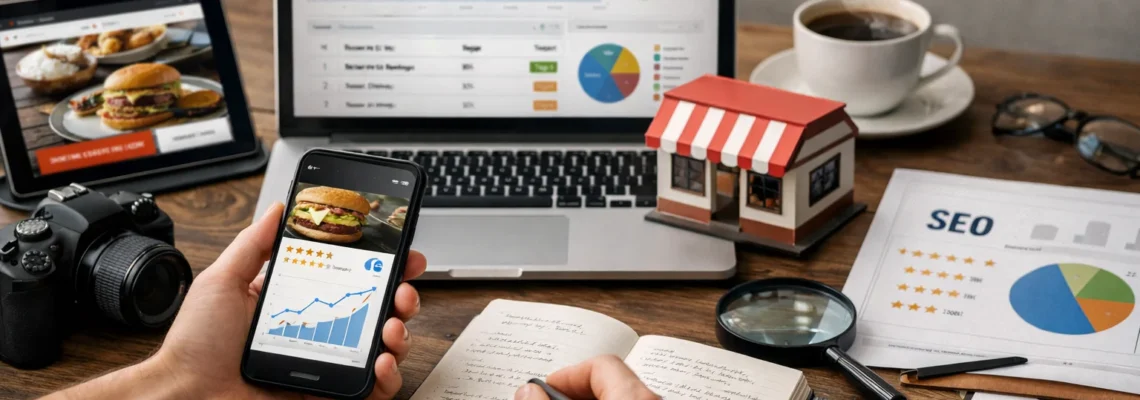
At 10:52 a.m., a café manager taps refresh on the map listing on her phone while a laptop beside the register shows reviews, opening hours, and menu photos side by side. The espresso machine is hissing. Lunch prep is starting. And she’s staring at that screen like it might decide whether the room fills up by noon.
Honestly? It kind of will. That little scene is restaurant online visibility in real life. Not theory. Not fluffy branding talk. It’s the daily job of making sure people can find you, trust what they see, and choose you before they choose the taco place two blocks away.
I’ve watched this play out with neighborhood cafés, family diners, and polished multi-location groups. In 2025, every restaurant is online — even the smallest corner spot shows up somewhere on Google Maps, Instagram Reels, TikTok, and delivery apps. But being visible is not the same as being picked. A place can appear everywhere and still lose covers because the photos look old, the menu link is broken, or Sunday hours are wrong.
Fundamentals of Restaurant Online Visibility
What counts as online visibility across search, maps, social, and delivery apps
When most owners hear “visibility,” they think SEO. That’s part of it, sure. But for restaurants, the job is bigger. Your online presence lives across local search, map apps, your website, social platforms, review sites, and delivery marketplaces. A hungry customer might discover you on TikTok at 11 a.m., check Google Maps at 12:15, skim your Instagram at 12:17, and place an order through DoorDash at 12:20.
So what counts? Your Google Business Profile. Apple Maps. Yelp. TripAdvisor. Your website’s menu pages. Instagram highlights. Reels. TikTok clips. Delivery app profiles. Reviews. Photos. Reservation links. Open-now badges. Even your answers to common questions. Restaurant online visibility is a multi-channel problem, not just an SEO problem.
Why visibility matters for discovery, trust, and foot traffic
People don’t search for food the way they search for a tax attorney or a roofing company. They’re fast. Emotional. Often hungry. They want reassurance in seconds. Is it nearby? Is it open? Does the food look good? Can I bring kids? Is there a patio? Are prices reasonable?
That’s why visibility matters beyond rankings. It drives discovery, yes, but it also creates trust before a guest ever touches the door handle. Google Maps is often the first place hungry customers check when deciding where to eat. If your listing shows sharp food photos, accurate hours, recent reviews, and a clean menu link, you feel safe. And safe gets clicks.
If people can’t find you, they can’t choose you — but if they find you and don’t trust what they see, they still won’t convert.
The difference between visibility, discovery, and conversion
This distinction trips people up all the time. Visibility means you appear. Discovery means someone notices you. Conversion means they actually do something useful — call, book, visit, order, or ask for directions.
| Stage | What it means | What the guest sees | What usually breaks |
|---|---|---|---|
| Visibility | You appear on maps, search, social, or apps | Your name, category, rating, photos | Weak listings, missing pages, bad categories |
| Discovery | The guest pauses and considers you | Reviews, menu, price cues, recent posts | Low trust, stale photos, thin menu info |
| Conversion | The guest takes action | Call, directions, booking, order, walk-in | Broken links, wrong hours, slow site, confusion |
And here’s the practical truth: visibility does not always mean discovery, and discovery does not guarantee conversions. If you remember only one thing from this page, remember that.
How Restaurant Online Visibility Works
How Google Maps and local search surface restaurants nearby
When someone types “brunch near me” or “best sushi open now,” search engines and map platforms try to answer a local intent question fast. Usually, they weigh a few obvious signals: how relevant your listing is to the search, how close you are, and how strong your presence looks compared with nearby options. Category choices, business description, hours, reviews, photos, and website signals all shape that picture.
Picture a traveler in Austin at 7:15 p.m. searching for “late dinner downtown.” If your restaurant is nearby, listed correctly as a restaurant instead of just a bar, marked open, and backed by solid reviews and good menu data, you’ve got a shot. If your hours are wrong or your listing still shows last winter’s menu photos, you start losing before the guest even clicks.
How reviews, ratings, and menu data influence choice
Once you appear, the next question is brutal and simple: “Do I trust this place?” Ratings help. Review recency helps more than people think. Responses matter too. A calm reply to a bad review tells the next 100 readers that somebody is paying attention.
Menu data pulls a lot of weight here. If guests can quickly see dishes, prices, dietary options, and photos, they feel oriented. If your profile says “Italian restaurant” but the linked menu is missing, prices are absent, and your top photo is an empty dining room, you’re making people work too hard.
Your restaurant is judged by the quality and consistency of its data as much as by your food.
- Recent, believable reviews reduce uncertainty.
- Star ratings create a shortcut, even when they aren’t the full story.
- Complete menu details answer objections before they become drop-offs.
- Photos turn abstract cravings into “let’s go there.”
How owned channels and delivery platforms feed discovery
Your website, email list, and direct ordering flow are your owned channels. Your delivery apps, social platforms, and review sites are borrowed ground. You need both. Instagram or TikTok might create the craving. Google Maps might confirm you’re open. Your website might seal the deal for a reservation. Uber Eats or another app might win the order when convenience takes over.
This is also where operations quietly affect marketing. Deliverect, for example, lists branded website and app options, QR Code Ordering, menu optimization and performance alerts, Sentinel 24/7 store monitoring, and 1,000+ integration partners in its ecosystem. That’s a useful reminder: visibility is tied to systems, not just slogans. If your menu, POS, ordering flow, and listings don’t talk to each other, the guest feels the disconnect immediately.
| Channel | Main job | Typical customer moment |
|---|---|---|
| Google Maps / local search | Nearby discovery and trust check | “What’s open around me?” |
| Website | Depth, menu clarity, direct conversion | “Let me check the menu first.” |
| Instagram / TikTok | Attention and appetite | “That pasta looks unreal.” |
| Delivery apps | Convenience-led ordering | “I’m staying in tonight.” |
Best Practices to Improve Restaurant Online Visibility
Optimize your Google Business Profile and local listings
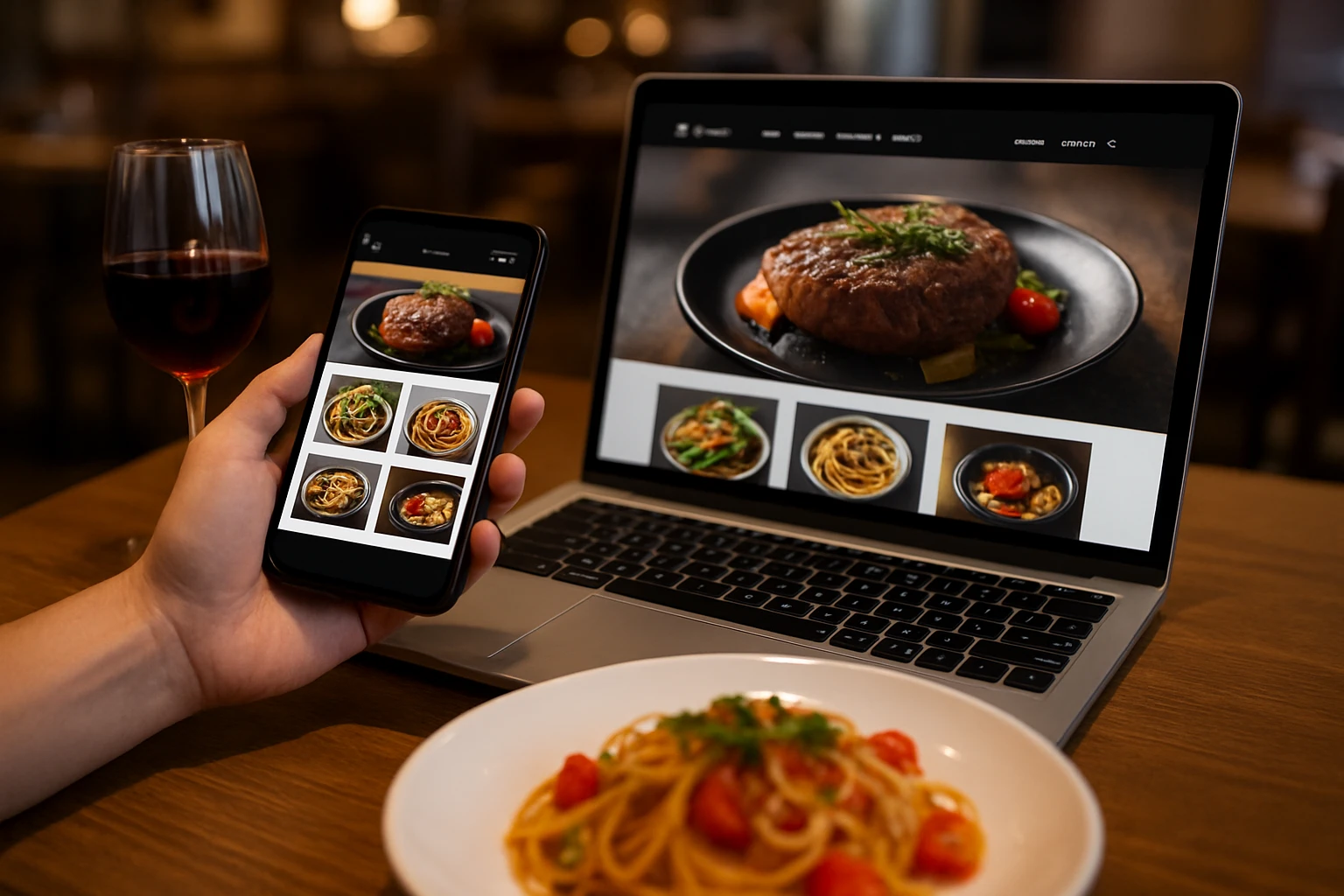
If you only have one hour this week, start here. Your Google Business Profile is usually the front door before the front door. Fill out every field you can actually maintain. Choose the right primary category. Add accurate hours, holiday hours, phone number, website link, reservation link, service options, and menu URL. Upload real photos — recent ones, not the grand-opening shots from 2022.
I like a simple rule: if a tired, hungry person can’t understand your offer in 20 seconds, your listing still needs work. Show exterior shots so people can recognize the building. Add interior photos so the vibe is clear. Use dish photos that reflect what actually lands on the table on a Friday night, not only styled hero shots from a one-time shoot.
Keep hours, address, menu, and photos consistent everywhere
Consistency sounds boring. It also saves sales. Your core business information should match across search, social, and ordering channels. Same address. Same phone number. Same opening hours. Same menu reality. If your website says you open at 11, your map listing says 10:30, and your delivery app says 11:30, guests stop trusting the whole brand.
One of the most common failures I see is simple drift. A restaurant updates its spring menu on the website, forgets the delivery apps, and leaves an old PDF linked on Google. Now the burger is $16 in one place, $18 in another, and missing entirely somewhere else. That doesn’t just create confusion. It makes people wonder what else is sloppy.
Consistency beats creativity when customers are deciding in seconds.
- Update holiday and special-event hours before the rush.
- Use the same spelling, suite number, and contact details everywhere.
- Replace dead menu links immediately.
- Refresh photos when plating, décor, or signage changes.
Use reviews, social posts, and menu content to reinforce credibility
The strongest restaurant visibility work doesn’t stop at showing up. It answers doubt. Reviews do that. So do social posts. So does menu content that feels complete instead of rushed. Most practical advice on this topic keeps circling the same pillars — Google Maps visibility, SEO basics, social strategy, and food photography — because those are the pieces guests actually use to decide.
Ask for reviews without being weird about it. Respond quickly, especially to factual complaints about wait times, wrong orders, or outdated hours. Post content that reflects the real guest experience: lunch specials, seasonal dishes, patio weather, behind-the-scenes prep, a busy dining room at 6 p.m. High-quality food photography helps customers understand what you serve before they ever visit. That sounds obvious. It still gets ignored.
| Signal | Good standard | What it tells the guest |
|---|---|---|
| Photos | Fresh, clear, realistic | “I know what I’m getting.” |
| Reviews | Recent, varied, answered | “This place is active and accountable.” |
| Menu content | Complete, accurate, easy to read | “This fits my taste and budget.” |
Common Mistakes That Hurt Visibility
Inconsistent hours, addresses, and menu details
This is the silent killer. Not bad branding. Not weak captions. Bad basics. If one profile says you’re open and the locked door says otherwise, people remember the frustration more than the food. A single outdated profile can create confusion across the entire customer journey because restaurants are visible on multiple platforms at once.
I’ve seen this happen on holiday weekends more times than I can count. Google says open. Instagram bio says open. The door sign says closed. One family with two kids turns around, leaves a one-star review, and tells their friends. All from one missed update.
Ignoring reviews or responding too slowly
You do not need to win every argument online. You do need to show up. When guests complain about stale fries, rude service, or inaccurate hours and hear nothing back for two weeks, your silence becomes part of the brand. A fragmented presence already makes people uneasy; silence confirms the problem.
Respond fast to factual issues. Thank people for praise. Acknowledge mistakes without writing a legal brief. If three reviews in a month mention slow pickup times, that’s not just a reputation issue. It’s an operations issue bleeding into visibility.
Treating visibility as a one-channel problem
Some restaurants pour everything into SEO and ignore social. Others build a gorgeous Instagram feed while their map listing is half-empty. Some obsess over delivery apps and forget the website menu is unreadable on mobile. None of those approaches hold up for long.
Visibility alone is not enough; even discovery does not guarantee conversions. More impressions won’t help if the click lands on outdated information, weak photos, or a broken ordering flow. Restaurant online visibility works when search, maps, reviews, menus, and social all support the same story.
More impressions won’t fix a broken profile.
| Mistake | What the guest feels | Fix this week |
|---|---|---|
| Conflicting hours | “Can I trust this place?” | Audit every major profile and update them together |
| No review responses | “Nobody’s paying attention” | Set a daily or twice-weekly response window |
| Only one active channel | “Something feels off” | Align maps, website, social, and ordering info |
Tools and Resources for Restaurant Visibility
Listing and review management tools
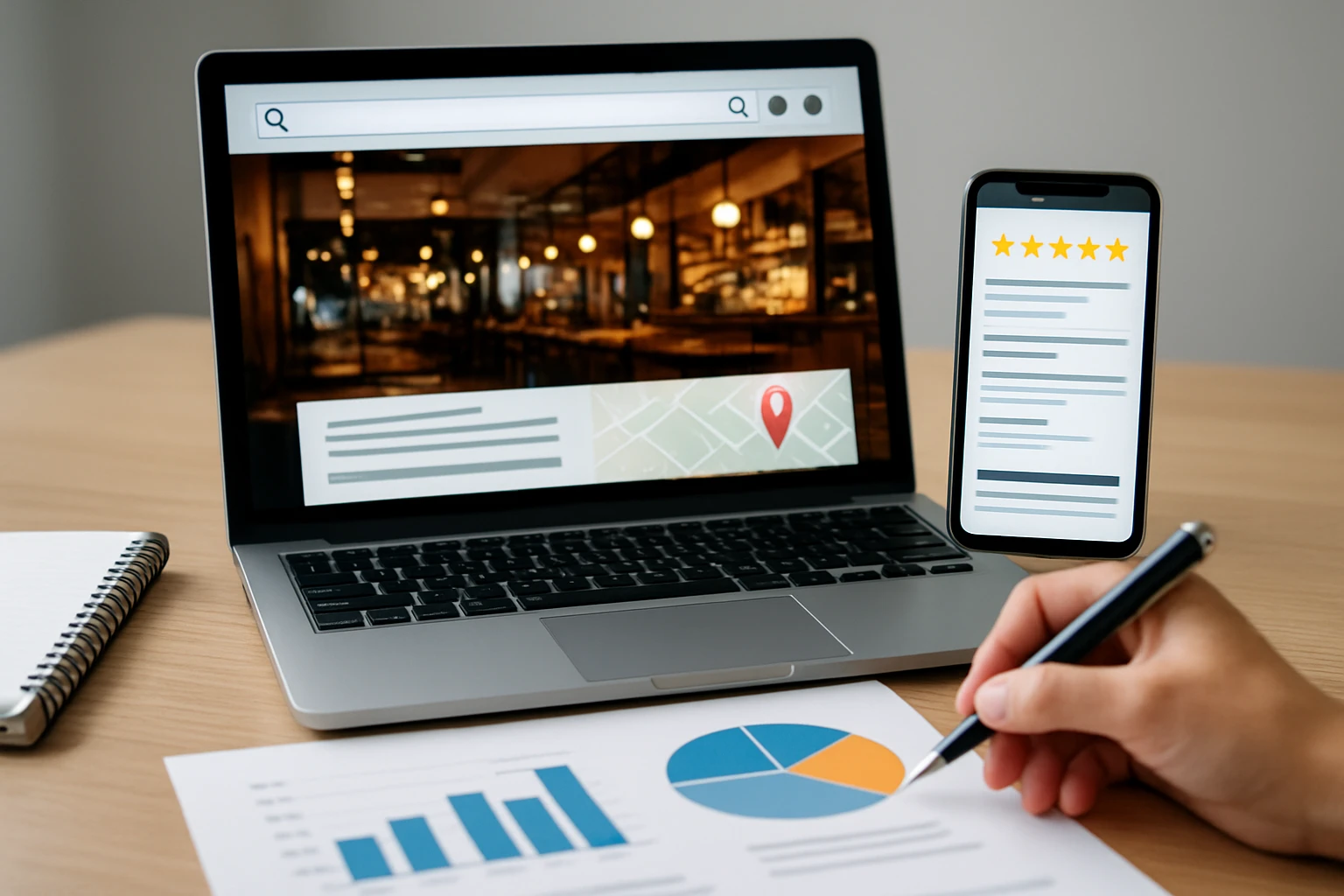
You do not need a giant software stack to get organized. A single-location café can make real progress with Google Business Profile, Apple Business Connect, Yelp, TripAdvisor, and a disciplined review-response process. If you run several locations, listing management platforms can help keep business data synchronized and reduce manual errors.
Start with the tools that control what guests see first. Then ask a boring but useful question: who owns updates? If nobody owns them, the tool won’t save you. I’ve seen a shared spreadsheet outperform expensive software simply because one manager actually maintained it every Monday.
Analytics, reporting, and search monitoring
You can’t improve what you never measure. Use website analytics, search performance data, map insights, call tracking where appropriate, and order reports from your direct or third-party platforms. Watch for spikes and drop-offs. If directions requests rise after new photos go live, that’s a clue. If profile views are flat but branded searches climb, that’s another clue.
Search monitoring tools help you spot whether you’re actually becoming easier to find for queries like “best burgers near me” or “gluten-free pizza downtown.” Just don’t confuse rank checking with business performance. A higher position that produces no calls, orders, or visits is a vanity win.
Menu, ordering, and integration platforms
This is where visibility meets operations. Menu sync tools, direct ordering systems, QR code menus, and integration platforms reduce the messy handoffs that create bad guest experiences. Deliverect is one example worth noting because it explicitly connects visibility-adjacent functions: branded website and app, QR Code Ordering, menu optimization and performance alerts, 24/7 monitoring, and 1,000+ integration partners.
That matters because every manual update is a chance for drift. One wrong item description, one missing modifier, one stale photo — and now your online presence is working against you.
Choose tools that reduce manual errors and keep every customer-facing channel in sync.
| Tool category | What it helps with | Best fit |
|---|---|---|
| Listing management | Hours, address, business data consistency | Multi-location groups, busy operators |
| Review management | Monitoring and replying at scale | Teams with high review volume |
| Analytics and search tracking | Measuring calls, clicks, directions, rankings | Any restaurant serious about growth |
| Menu and ordering integrations | Keeping menus and ordering accurate across channels | Delivery-heavy or multi-system operations |
How to Measure and Maintain Visibility Over Time
Track impressions, clicks, calls, directions, and orders
If visibility does not always lead to discovery or conversion, then traffic alone is a weak scoreboard. You need to measure the full path. Watch impressions and views, yes. But also clicks to the website, calls from listings, direction requests, reservation starts, online orders, and review volume.
A bakery might care most about direction requests and phone calls before 8 a.m. A ghost kitchen might care more about delivery app impressions and conversion rates. A date-night bistro may care about reservation clicks on Friday afternoons. Different model, different signal.
| Metric | Why it matters | Warning sign |
|---|---|---|
| Listing impressions | Shows whether you’re appearing | Flat or declining despite active updates |
| Website clicks | Measures deeper interest | High impressions, low clicks |
| Calls / directions | Strong intent signals for local traffic | Sudden drop after hours or profile changes |
| Orders / reservations | Ties visibility to revenue | Traffic rises but conversions stay flat |
| Review volume and rating trends | Tracks trust over time | Older reviews dominate or complaints repeat |
If you don’t measure the full path from search to visit to order, you’re optimizing blind.
Audit listings, photos, reviews, and menus monthly
I’m a big fan of the first-Monday audit. Nothing fancy. Just a recurring 30-minute check. Open your Google listing, website, Instagram bio, delivery app profiles, and major review sites. Confirm hours, address, phone, menu link, reservation link, top photos, and recent reviews. Done.
Make it seasonal, too. Patio opens in April? Update the photos. Holiday catering starts in November? Add those offers everywhere. New signage goes up? Replace exterior shots. Regular maintenance across maps, social, and delivery channels is not glamorous, but it keeps small mistakes from turning into expensive leaks.
Turn performance data into a recurring update process
Data matters only if it changes behavior. So build a simple operating rhythm:
- Weekly: check reviews, calls, directions, and any obvious profile issues.
- Monthly: audit every major customer-facing channel.
- Quarterly: refresh photos, menu positioning, and local search targets.
- Before peak seasons: update hours, specials, and landing pages.
Operational monitoring and menu or performance alerts can help teams catch issues faster, especially when you’re juggling multiple systems. That’s why platforms that combine menu control, ordering, and monitoring can be useful. They don’t replace strategy. They do make execution less fragile.
Restaurant online visibility gets easier when you stop treating Google Maps, Instagram, your menu, and delivery apps like separate jobs and run them like one system.
Accurate hours earn trust. Fresh photos spark appetite. Clean listings, recent reviews, and reliable ordering paths turn curiosity into real visits and real orders.
When you look at your own presence tonight, what’s the first broken touchpoint you’ll fix — the map listing, the menu, the reviews, or the photos?
Expand Local Reach With Internetzone I
Internetzone I combines National & Local SEO with web design, PPC, eCommerce, and reputation management to help companies get found, trusted, and chosen online.