
If you’ve ever stared at a blank spreadsheet wondering where your next traffic spike will come from, the keyword planner by google is the reliable, free power tool you might be underusing. I’ve sat in countless strategy rooms where teams debated audience personas and messaging, but the big wins often followed disciplined keyword discovery. Ready to find the phrases your buyers actually type, not the ones we wish they used? In this guide, I’ll show you exactly how Internetzone I turns raw planner data into real Search Engine Optimization (SEO) traction and Pay Per Click (PPC) gains, step by step.
Before we dive in, a quick mindset shift helps. Think of search data like a bustling marketplace where intent hums in every aisle. Your job isn’t just to count shoppers, but to overhear what they ask for and stock that shelf first. When you combine keyword clusters with buyer intent and location signals, you build pages and ads that feel almost telepathic. That’s the edge Internetzone I brings to National and Local Search Engine Optimization (SEO), supported by Web Design that’s mobile responsive and SEO-focused, eCommerce solutions, Reputation Management, AdWords-Certified Pay Per Click (PPC) Services, and Managed Web Services designed to compound your results.
Why the keyword planner by google Still Wins in 2025
Can a free tool still compete with premium platforms? Absolutely, when you know how to read the room. The keyword planner by google taps directly into Google Ads (Google Advertising) query data, making it an underrated goldmine for Search Engine Optimization (SEO) and Pay Per Click (PPC) planning. Industry studies consistently show that long-tail keywords drive a large share of organic traffic because they mirror real questions and buying moments. Better yet, planner data pairs search volume with “top of page bid” ranges, an elegant proxy for commercial value. In other words, you see demand and dollars, side by side.
Another reason it shines is speed. With a few filters, you can help infer commercial vs informational intent, separate branded vs non-branded terms, and refine geo-targeting from national down to city or postal-code levels where supported. If you’ve ever wrestled with mismatched content and the wrong visitors, this is the fix. At Internetzone I, we start most engagements by mapping planner insights to your customer journey, then feed those insights into National and Local Search Engine Optimization (SEO), Web Design, and AdWords-Certified Pay Per Click (PPC) builds. When your message, offer, and location cues line up, your Click Through Rate (CTR) climbs and your Return on Investment (ROI) tends to follow.
7 Agency-Proven Tactics That Uncover Hidden, High-Converting Keywords
1) Start With Sites, Not Just Words
Watch This Helpful Video
To help you better understand keyword planner by google, we’ve included this informative video from Surfside PPC. It provides valuable insights and visual demonstrations that complement the written content.
Begin with the “Start with a website” option and drop in your domain plus a top competitor. The planner uses the Uniform Resource Locator (URL) as a seed and suggests semantically related topics you might not think to type as seed keywords. Pro tip from Internetzone I: run your product categories and service pages individually to avoid muddy averages. If you’re a regional clinic, scan each service page; if you’re an eCommerce store, scan category and high-margin product pages. Export results, tag by page type, and you’ll discover clusters begging for landing pages and internal links. This is how we uncover “near me” variants, procedure synonyms, and overlooked modifiers like “same day,” “after hours,” and “open Saturday.”
2) Slice Intent With Include, Exclude, and Refine
The fastest way to shrink noise is to filter. Use “Include” and “Exclude” to segment transactional phrases like “buy,” “pricing,” and “quote” from informational ones like “how to” and “best.” Then use “Refine keywords” to group by brand, category, or attribute. Why does this matter? Pages that match intent tend to enjoy higher Click Through Rate (CTR) and better engagement. At Internetzone I, transactional buckets inform product or service pages plus Pay Per Click (PPC) ad groups, and informational buckets fuel blog hubs and guides. Over a quarter, this split alone can cleanly raise organic leads because users finally land on what they meant to find.
3) Layer Locations for National and Local Wins
Toggle the location field to compare national demand to your best-performing states, cities, or even neighborhoods. You’ll see surprising pockets where a generic term quietly transforms into a local best seller. For example, “emergency plumber” becomes “24 hour plumber [city]” with better close rates in metro ZIP codes. Internetzone I pairs this with National and Local Search Engine Optimization (SEO) site architecture: national pages for broad terms, city pages for localized variants, and embedded Name, Address, Phone (NAP) blocks to reinforce local presence. The keyword planner by google provides the map. Your content and citations provide the vehicle.
4) Use Forecasts to Time Content and Budgets
Switch to the Forecast view to see expected impressions and clicks for your terms. While built for Google Ads (Google Advertising), those trendlines help you schedule content and landing pages ahead of seasonal peaks. Retailers can move gift guides earlier, service brands can prep “winterization” or “tax season” pages before demand spikes. At Internetzone I, we convert Forecast momentum into editorial calendars and Pay Per Click (PPC) budgets, then watch for off-season gems with stable demand. That blend keeps Search Engine Optimization (SEO) producing year round and lets Pay Per Click (PPC) lean in when the iron is hottest.
5) Score Commercial Value With Bid Ranges
Not all volume is equal. “Top of page bid” gives a practical look at advertiser willingness to pay. We weight candidates with a simple model: normalize search volume, normalize top bid, apply intent multipliers, then sort by total score. It’s a back-of-napkin formula that punches above its weight. In our experience at Internetzone I, keywords with mid-to-high bids and clear transactional language often become your most reliable revenue pages. Informational keywords can still be valuable, of course, just routed to guides, comparison posts, and email capture.
6) Mine Competitor Gaps With Site Scans
Drop a competitor’s Uniform Resource Locator (URL) and capture the keyword list. Filter out branded terms and high-overlap phrases you already rank for, then keep the rest as “steal” targets. You’ll find head terms they ignored and long-tail variations they rank for but monetize poorly. Internetzone I turns those into content briefs, page templates, and Pay Per Click (PPC) tests so we can see which phrases convert before we scale content production. When you win where a rival is complacent, your Search Engine Results Page (SERP) share climbs quietly and steadily.
7) Build SEO and PPC Synergy With Negatives and Clusters
Last, connect the dots. For Pay Per Click (PPC), add negative keywords to protect budgets from ambiguous or research-only queries. For Search Engine Optimization (SEO), cluster your planner terms by topic, not just exact match, and build one comprehensive page per cluster. The planner’s groupings help decide which subtopics live on the page and which deserve their own URL. At Internetzone I, this alignment reduces cannibalization, lowers Cost Per Click (CPC), and increases Return on Investment (ROI) because your ads and organic pages reinforce each other instead of competing.
Make Better Decisions Faster: The Planner Filters That Matter Most
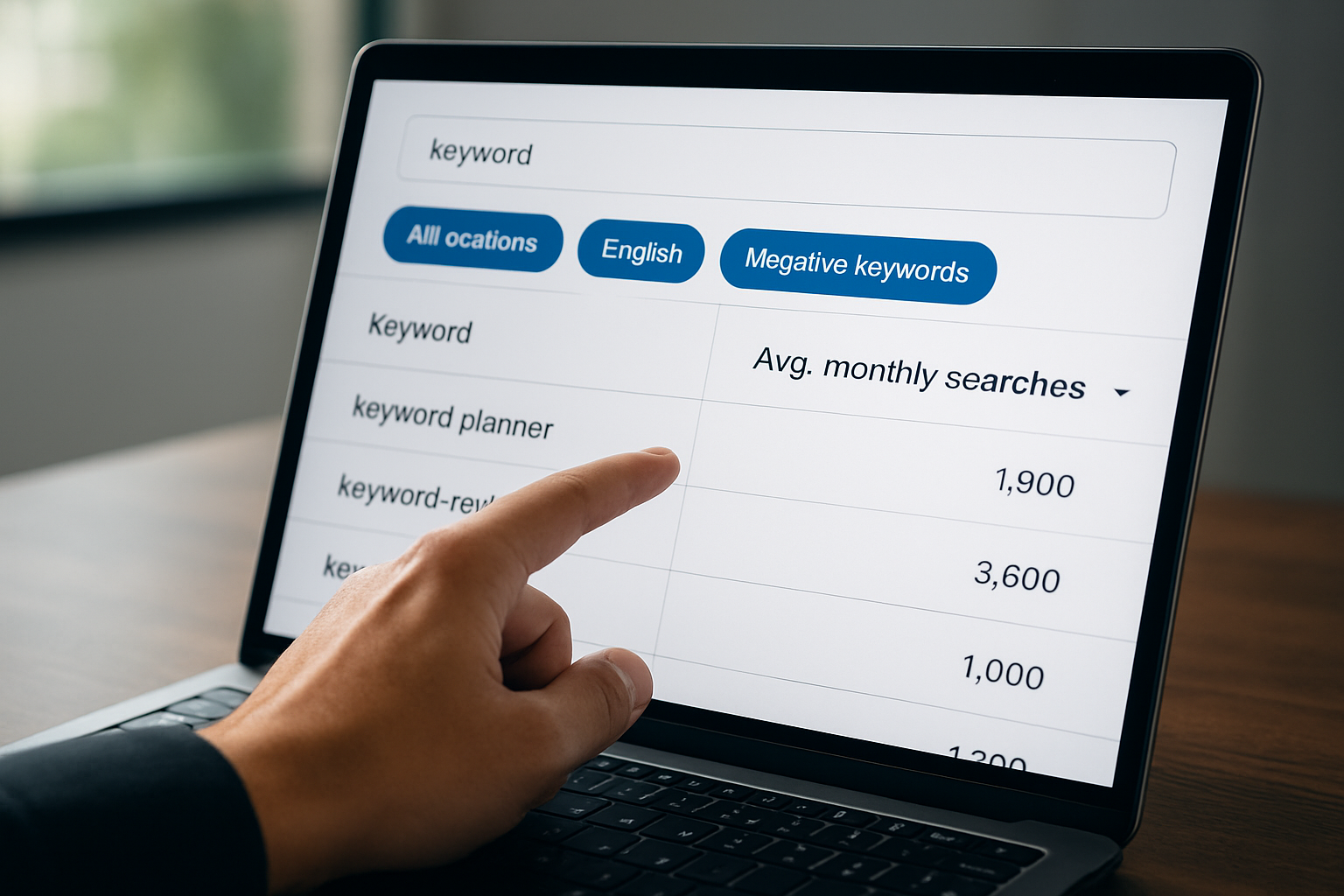
Filters are where you trade guesswork for clarity. Yet many teams stop at search volume, which is the least predictive metric on its own. The magic combo pairs volume with intent, competitive density, and what we call “win-ability,” your realistic chance to rank or convert given your resources. When Internetzone I evaluates a new account, we run a standard operating procedure: segment by intent, layer locations, remove brand noise, and prioritize commercially valuable terms with content or ad gaps. The outcome is a short list you can actually act on this quarter rather than a 4,000-row spreadsheet everyone will ignore.
Use the table below as a quick-reference when you’re inside the keyword planner by google. If you’re multitasking, screenshot it and keep it by your desk. The right filter at the right time can save hours and prevent rabbit holes that lead nowhere.
| Filter or Field | What It Reveals | Agency Tip From Internetzone I |
|---|---|---|
| Locations | National vs city-level demand shifts | Build a national hub and city pages where local modifiers surge |
| Include/Exclude Keywords | Intent segmentation by phrase | Create separate lists for transactional, informational, and navigational terms |
| Refine Keywords | Automatic groupings by brand, category, attribute | Use groups as seed clusters for content outlines |
| Top of Page Bid (High) | Monetization potential | Weight these higher in scoring when budgets are tight |
| Competition | Advertiser density | High competition plus high bids often signals conversion-friendly intent |
| Date Range | Seasonality and trend direction | Plan content 4 to 8 weeks ahead of peaks shown in forecasts |
Local vs National: Architect Your Site Around Real-World Demand
One of the most expensive mistakes in Search Engine Optimization (SEO) is treating local and national demand the same. The keyword planner by google shows you where intent flips from general browsing to urgent buying simply by adding a city name or “near me.” Internetzone I uses these signals to design site architecture: national pages for core definitions and comparisons, then location pages that speak to distance, hours, and unique offers. This approach preserves topical authority while letting you compete for fast-closing searches in specific markets. It’s the difference between being visible and being chosen.
Curious how drastically phrasing changes behavior? Here’s a snapshot based on aggregated, anonymized account patterns we commonly see. Your mileage will vary, but the directional takeaway stays consistent: local modifiers concentrate intent.
| Query Pattern | Likely Intent | Page Type | Conversion Likelihood |
|---|---|---|---|
| “best [service]” | Research, comparison | Guide, comparison hub | Medium |
| “[service] pricing” | Commercial investigation | Pricing page, calculator | Medium to High |
| “[service] near me” | Local, urgent | City page, click-to-call | High |
| “24 hour [service] [city]” | Emergency, immediate | Emergency landing page | Very High |
From Data to Dollars: Scoring Keywords and Prioritizing Pages

You don’t need a PhD to rank, but you do need a repeatable scoring system. Internetzone I uses a simple composite that any team can replicate in a spreadsheet. Normalize search volume to a 1 to 10 scale. Normalize top-of-page bid (high) to a 1 to 10 scale. Assign an intent multiplier: 1 for informational, 1.3 for commercial investigation, 1.6 for transactional, 1.8 for emergency or “near me.” Your final score is Volume x Bid x Intent. Then apply a feasibility check: if the current top Search Engine Results Page (SERP) is dominated by authoritative domains, either reshape the angle to a long-tail variant or plan a supporting content cluster first.
Next, map each winner to a specific page with a clear call to action and a content outline that covers subtopics surfaced in planner groupings. For Search Engine Optimization (SEO), that means headings that echo your cluster without stuffing. For Pay Per Click (PPC), create tightly themed ad groups and ensure landing pages mirror user language. Our teams at Internetzone I also add a confidence note for each pick: “Quick win,” “Medium effort,” or “Moat build.” This helps stakeholders balance fast results with long-term defensibility.
Real-World Wins With Internetzone I: Two Quick Case Snapshots
Stories beat theory, right? Here are anonymized, representative snapshots from Internetzone I engagements where the keyword planner by google played a starring role. They show how a disciplined workflow translates into measurable traction across Search Engine Optimization (SEO) and Pay Per Click (PPC), supported by Web Design and Reputation Management to turn attention into trust.
| Business | Challenge | Planner-Driven Move | 90-Day Outcome |
|---|---|---|---|
| Regional Dental Network | Low local visibility and high Pay Per Click (PPC) costs | Built city pages for “emergency dentist [city]” and added negatives for “free” queries | +38 percent organic calls, -22 percent Cost Per Click (CPC), stronger ratings via Reputation Management |
| Specialty eCommerce Retailer | High traffic, weak sales | Prioritized high-bid long-tail product modifiers, rewrote templates via SEO-focused Web Design | +29 percent revenue from organic, +17 percent Return on Investment (ROI) in Pay Per Click (PPC) |
In both cases, the through-line was the same: listen to demand signals, mirror buyer language, respect location nuances, and build pages that close the loop. Internetzone I’s integrated stack — National and Local Search Engine Optimization (SEO), AdWords-Certified Pay Per Click (PPC), mobile responsive Web Design, eCommerce development, Reputation Management, and Managed Web Services — ensured every insight found a home, whether that was a city page, a product template, or a tuned landing page aligned with ad copy.
Your 90-Day Keyword Roadmap: Simple, Fast, Repeatable
If you like clarity, you’ll love a 90-day plan. The keyword planner by google gives you the inputs, but the cadence gives you momentum. Here’s a lightweight program Internetzone I adapts for companies of all sizes aiming to enhance their online visibility, reputation, and overall digital marketing performance. It balances quick wins with compounding gains, and it keeps everyone focused on outcomes, not vanity metrics.
- Week 1 to 2: Discovery
- Scan your site and two competitors with “Start with a website.”
- Segment results by intent using Include, Exclude, and Refine.
- Create separate national and top-5 city lists.
- Week 3 to 6: Build
- Draft outlines for 2 national hubs and 3 city pages aligned to transactional clusters.
- Launch one new Pay Per Click (PPC) ad group to validate high-bid keywords; add negatives for poor matches.
- Update templates with SEO-focused Web Design best practices and faster load times for better User Experience (UX).
- Week 7 to 10: Expand
- Publish supporting posts for long-tail variants and internal link to target pages.
- Use Forecasts to plan a seasonal push; adjust budgets and content queue.
- Begin light Reputation Management to earn fresh reviews on city pages.
- Week 11 to 12: Optimize
- Review rankings and Click Through Rate (CTR); refresh titles and meta descriptions where needed.
- Pause low-performing Pay Per Click (PPC) terms; reinvest in proven keywords.
- Finalize next-quarter cluster map based on what converted best.
By the end of 90 days, you’ll have a lean, scalable system. Most importantly, you’ll know which keyword families deserve more content, which deserve more bids, and which to leave behind. That confidence compounds across quarters, which is exactly how Internetzone I helps clients grow online through coordinated Search Engine Optimization (SEO), Pay Per Click (PPC), Web Design, eCommerce, and Reputation Management.
Quick FAQ
- Is the planner only for ads? No. While it serves Google Ads (Google Advertising), its demand and bid data supercharge Search Engine Optimization (SEO) planning.
- How often should I refresh research? Quarterly works well, with monthly checks for seasonal industries.
- What’s a good benchmark? Instead of a single number, track Click Through Rate (CTR), qualified leads, and Return on Investment (ROI) per cluster.
Pro tip: Download results as a Comma Separated Values (CSV) file, add your scoring columns, and keep a “decision” field so future you remembers why a keyword was kept or cut. That little habit saves teams from repeating debates and keeps your pipeline moving forward.
The promise of this playbook is simple: use real demand signals to publish fewer, better pages that convert. In the next 12 months, steady execution can turn scattered keywords into a resilient moat of category authority. Which tactic will you test first, and how will you measure the lift inside the keyword planner by google?
Additional Resources
Explore these authoritative resources to dive deeper into keyword planner by google.
Amplify Keyword Planner By Google Impact with Internetzone I
Harness National & Local SEO with Internetzone I to turn keyword planner by google insights into visibility, stronger reputation, and better marketing performance for companies of all sizes.