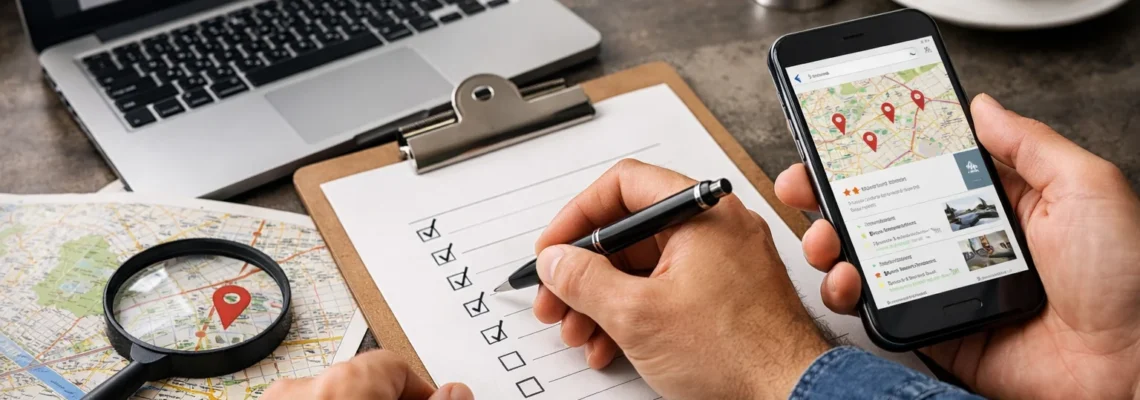
If you’ve ever felt overwhelmed by all the moving parts of local seo marketing services, you’re not alone. One algorithm update here, a new review there, and suddenly your phones go quiet. That’s why having a clear, practical checklist is a lifesaver. Think of it like mise en place for growth. When you line up the right research, tools, and steps before you start, you reduce waste, accelerate wins, and protect your budget. And here’s the kicker many teams miss: local visibility compounds. Nail consistent signals and intent-focused content now, and you’ll see measurable gains in calls, foot traffic, and revenue for months to come. Internetzone I specializes in SEO [Search Engine Optimization], PPC [Pay Per Click], web design, eCommerce, and reputation management, and we’ve seen businesses unlock rapid growth just by tightening basics you can tackle this week.
Quick reality check. Nearly 76 percent of people who search for something nearby visit a business within a day, and about 28 percent of those visits end in a purchase, according to widely cited Google local research. That means your customers are not just window shopping online; they’re ready to buy. The goal of this guide is to help you capture that intent with an easy-to-follow set of actions across research, execution, and validation. Along the way, I’ll note where Internetzone I’s National & Local SEO [Search Engine Optimization] approach, Adwords-Certified PPC [Pay Per Click] Services, and Managed Web Services tie in to make your life easier. Ready to turn “near me” into “right now”? Let’s go.
Pre-work checklist
Measure twice, grow once. Before you publish a single location page or tweak a listing, lay the groundwork that keeps everything aligned. This pre-work ensures your brand says the same thing everywhere, your content answers local intent, and your tracking captures every call and click. Skipping this part is like building a storefront without an address. In our experience at Internetzone I, teams that intentionally map goals, competitors, and technical requirements up front shorten time to impact by weeks. Use the actions below to get momentum on your side.
- Define outcomes and KPIs [Key Performance Indicators]. Pick three measurable outcomes that matter: qualified calls, booked appointments, and in-store visits. Tie each to a KPI [Key Performance Indicator] like call volume, booking form submissions, and direction requests. Clarity beats vanity metrics every time.
- Audit NAP [Name, Address, Phone number] consistency. Document the exact way your business name, address, and phone appear. Standardize the format and correct inconsistencies on your website, listings, and top directories. Consistency helps search engines trust your entity and connect you to the right map pins.
- Research local keywords and intent. Build a list that mixes service terms plus city or neighborhood modifiers, plus “near me” phrases and problem-based queries. Analyze SERP [Search Engine Results Page] features to see whether map packs, reviews, or guides dominate for each query. Map keywords to pages before you write.
- Profile the top three competitors per location. Note their primary GBP [Google Business Profile] category, review velocity, location page structure, and backlink sources. Gaps you spot here become fast wins when you fill them with better content or clearer signals.
- Set up GA4 [Google Analytics 4], GSC [Google Search Console], and call tracking. Create conversion events for calls, forms, and direction clicks. Use UTM [Urchin Tracking Module] parameters on GBP [Google Business Profile] links and ads to see what actually drives revenue. Good data makes every next step easier.
- Choose your service area strategy. If you serve a radius, define it and confirm that your GBP [Google Business Profile] reflects “service area business.” If you have storefronts, list their exact hours and accessibility details. Align your approach with how customers truly reach you.
- Plan your content architecture. Draft a simple site map with one page per primary service and one page per location. Add supporting content like neighborhood guides, comparison pages, and FAQ [Frequently Asked Questions] sections to answer buyer questions and earn topical authority.
- Harden your website foundation. Confirm your CMS [Content Management System] generates fast pages, clean URLs, and schema options. Internetzone I’s Web Design offering focuses on mobile responsive, SEO [Search Engine Optimization]-ready templates that pass Core Web Vitals and keep users on the page.
- Collect social proof at the source. Train your team to ask for reviews right after service is delivered. Create a simple handout with a short URL and QR code that routes to your GBP [Google Business Profile]. Momentum beats memory when it comes to reviews.
- Decide build vs partner. Be honest about bandwidth and expertise. Many teams benefit from a partner who brings process, tools, and accountability. If that’s you, Internetzone I’s Managed Web Services keep execution humming while you focus on operations.
Still weighing whether to keep everything in-house or bring in help? Use this quick comparison to choose your path with eyes wide open.
| Option | Speed to Impact | Expertise Depth | Tools Included | Best For |
|---|---|---|---|---|
| DIY In-House | Slow to Medium | Varies by team | Basic analytics stack | Early-stage teams learning the ropes |
| Generic Agency | Medium | Mixed, often templated | Limited local toolset | Simple, single-location needs |
| Internetzone I | Fast | National & Local SEO [Search Engine Optimization], Adwords-Certified PPC [Pay Per Click] Services, Reputation Management, eCommerce, Web Design | Tracking, dashboards, schema, reporting | Multi-location, competitive markets, growth-focused teams |
Execution checklist for local seo marketing services

Watch This Helpful Video
To help you better understand local seo marketing services, we’ve included this informative video from Payton Clark Smith. It provides valuable insights and visual demonstrations that complement the written content.
With the groundwork set, it’s time to build. Execution is where you turn research into revenue. Focus on the levers that move local rankings and conversions together: authoritative listings, intent-matched pages, fast experiences, and real-world trust signals. If you want a mental model, think of proximity, relevance, and prominence as your three dials. You can’t move the pin closer to a searcher, but you can out-relevant and out-prominent competitors with better content, consistent citations, quality backlinks, and delighted customers.
- Claim and fully optimize your GBP [Google Business Profile]. Choose the correct primary and secondary categories, add services and products, write a keyword-informed description, and enable messaging. Post weekly updates and add Q and A [Questions and Answers] that mirror common buyer questions.
- Build conversion-ready location pages. Create one high-quality page per location with unique copy, embedded map, NAP [Name, Address, Phone number], parking or transit details, testimonials, and a clear CTA [Call To Action]. Add LocalBusiness schema using JSON-LD [JavaScript Object Notation for Linked Data] to reinforce your data.
- Structure service pages for intent. Use headings that match problems customers actually search. Add FAQs [Frequently Asked Questions], pricing ranges, and process steps. Internally link from service pages to the nearest relevant location page.
- Standardize citations on top directories. Submit to core platforms plus industry-specific sites. Keep NAP [Name, Address, Phone number] and categories identical to GBP [Google Business Profile]. Revisit quarterly to correct changes.
- Turn reviews into a flywheel. Ask, respond, and learn. Target a steady cadence of fresh reviews mentioning your services and location. Reply within 24 hours and address negatives with empathy and specifics.
- Earn local backlinks with partnerships. Sponsor a neighborhood event, join your chamber page, and pitch helpful guides to local news. Quality local links strengthen your prominence more than random directory blasts.
- Speed up your site experience. Compress media, lazy-load below-the-fold assets, and trim unused code. Mobile responsive, SEO [Search Engine Optimization]-focused Web Design from Internetzone I can deliver the performance lift that keeps bounce rates low and conversions high.
- Add product and service highlights to GBP [Google Business Profile]. If you sell items, feature top sellers with prices and availability. For services, list offerings and include booking links. More structured data equals more conversion paths.
- Use PPC [Pay Per Click] to cover gaps while SEO [Search Engine Optimization] climbs. Bid on branded, local intent, and competitor terms to capture demand now. Internetzone I’s Adwords-Certified PPC [Pay Per Click] Services pair targeting with call tracking to prove what pays.
- Publish locally resonant content. Create “best of” neighborhood lists, maintenance checklists, seasonal guides, and comparison pages. Tie each post to your nearest location page to funnel authority and conversions.
- Track every touchpoint. Add UTM [Urchin Tracking Module] tags to GBP [Google Business Profile] URLs, enable call tracking, and set GA4 [Google Analytics 4] events for clicks, forms, and chats. What you measure, you can reliably improve.
- For eCommerce, sync local and online inventory. Highlight pickup options, local delivery windows, and store availability on product pages. Internetzone I’s eCommerce solutions connect catalog data with on-page SEO [Search Engine Optimization] and local messaging.
As a real-world example, a home services client partnering with Internetzone I added structured LocalBusiness schema, rebuilt location pages with unique value props, and launched weekly GBP [Google Business Profile] posts tied to seasonal demand. In 90 days, calls from map pack listings rose 41 percent, and organic conversions on location pages climbed 28 percent. The magic wasn’t a single hack. It was stacking consistent, high-quality signals.
| On-Page Element | Why It Matters | Quick Win |
|---|---|---|
| H1 and H2s | Clarify page topic and intent | Match one primary keyword plus city |
| Internal Links | Distribute authority and guide users | Link service pages to nearest location page |
| Schema Markup | Reinforces entity and services | Add LocalBusiness and FAQ [Frequently Asked Questions] via JSON-LD [JavaScript Object Notation for Linked Data] |
| Unique Media | Boosts relevance and trust | Feature store-specific details and testimonials |
| Page Speed | Improves engagement and rankings | Compress media and defer non-critical scripts |
Validation checklist
What you improve should show up in the numbers. Validation keeps you honest and helps you prioritize what to do next. Rather than obsess over daily rankings, look for directional movements in visibility, engagement, and conversions at 30, 60, and 90 days. Use the table below as your scoreboard, and keep a shared log of what you changed each week so you can attribute wins accurately.
- Document your baseline. Export top queries, impressions, and average position from GSC [Google Search Console]. Record GBP [Google Business Profile] calls, direction requests, and website clicks.
- Track map pack visibility by location. Use a grid-based rank tracker if available, or manually sample from key neighborhoods. Focus on query groups that match your services.
- Monitor conversions, not just traffic. In GA4 [Google Analytics 4], review events for calls, forms, chats, and clicks to call from mobile. Growing conversions confirm you’re attracting the right visitors.
- Analyze CTR [Click Through Rate] by query. Low CTR [Click Through Rate] with high impressions signals a title or meta description mismatch. Align copy with user intent and test again.
- Review quality of reviews. Measure average rating, review velocity, and keyword-rich mentions. Address patterns in negative feedback with operational fixes, not just replies.
- Re-crawl site health monthly. Fix broken links, duplicate titles, thin location pages, and schema errors. Small technical issues can quietly siphon conversions.
| Metric | Tool | Why It Matters | Baseline | 90-Day Target |
|---|---|---|---|---|
| GBP [Google Business Profile] Calls | GBP Insights | Measures local demand captured | 100 per month | 140 per month |
| Organic Conversions | GA4 [Google Analytics 4] | Revenue-focused validation | 60 per month | 85 per month |
| Map Pack Coverage | Rank Tracker | Visibility across neighborhoods | 30 percent of grid | 55 percent of grid |
| CTR [Click Through Rate] | GSC [Google Search Console] | Relevance of snippets | 3.2 percent | 4.5 percent+ |
| Citation Consistency | Manual Audit | Entity trust and accuracy | 80 percent accurate | 95 percent accurate |
Pro tip from the trenches. Tag every key link with UTM [Urchin Tracking Module] parameters, including GBP [Google Business Profile] website and appointment links. Pair that with call tracking and you’ll finally see which locations, listings, and pages make the phone ring. Internetzone I’s Managed Web Services bundle this tracking so you can spend time on decisions, not data wrangling.
Common misses

Even smart teams trip on the same handful of issues that quietly cap performance. The good news is each one has a clear, fixable root cause. Use this list to spot quick wins and avoid avoidable rework. If you see your current setup in any of these, you’re not alone, and you’re a couple of focused weeks from meaningful improvement.
- Wrong primary category in GBP [Google Business Profile]. This single choice can tank relevance. Check what the top ranking competitors use and align if it matches your actual service.
- Inconsistent NAP [Name, Address, Phone number] across listings. Clean up duplicates, fix outdated numbers, and ensure suite numbers and abbreviations match exactly. Trust is built on sameness.
- Thin, duplicate location pages. Copy-pasting with only city names swapped won’t cut it. Add unique value: staff highlights, neighborhood landmarks, pricing ranges, and testimonials specific to that location.
- Ignoring prominence signals. Reviews, local links, and brand mentions are your authority fuel. Create a monthly cadence for outreach and review requests to keep momentum.
- No schema or broken schema. Schema helps machines understand your business. Validate JSON-LD [JavaScript Object Notation for Linked Data] in Search Console and fix errors promptly.
- Poor mobile experience. Sluggish, cluttered pages kill conversions. Internetzone I’s Web Design focuses on mobile responsive, SEO [Search Engine Optimization]-friendly layouts that guide users to a clear CTA [Call To Action].
- Misaligned content to intent. Ranking for the wrong terms wastes clicks. Match pages to transactional, commercial, or informational intent and use SERP [Search Engine Results Page] clues to shape your format.
- Neglecting PPC [Pay Per Click] alignment. Organic and paid work better together. Use PPC [Pay Per Click] to capture competitor traffic and test messaging that you can then roll into SEO [Search Engine Optimization] titles and descriptions.
- Letting spam outrank you. Report keyword-stuffed or fake listings through “Suggest an edit” and focus on real-world prominence to rise above noise.
- No crisis plan for reviews. One viral complaint can dent conversions. Draft response templates, escalation paths, and empower staff to resolve issues fast. Internetzone I’s Reputation Management can help you prepare before you need it.
One more quick story. A regional retailer arrived with great products but confusing listings, sluggish pages, and recycled location copy. Internetzone I consolidated duplicate citations, rebuilt pages on a mobile responsive template, added LocalBusiness and FAQ [Frequently Asked Questions] schema, and aligned PPC [Pay Per Click] with top-converting search intent. Within a quarter, their map pack visibility doubled in core neighborhoods, and store visits from direction requests rose 33 percent. Most of that lift came from cleaning up avoidable misses.
Next Steps to Dominate Local Search
This entire playbook boils down to one promise: show up exactly where nearby buyers look, then make choosing you the easiest decision of their day.
In the next 12 months, the brands that blend entity clarity, fast experiences, authentic reviews, and helpful local content will own the map. Stack these actions, keep measuring, and compound your edge.
Which two actions will you start this week to move the needle on your local seo marketing services?
Elevate Local Search with Internetzone I
Power your local seo marketing services with National & Local SEO to boost visibility, trust, and revenue for companies of all sizes with Internetzone I.