
Choosing the right pay-per-click advertising agency can feel like picking a co-pilot for a long-haul flight: you want skill, a steady hand, and constant communication. You are entrusting real budget and real growth targets to a team you might not know yet. So how do you tell a true partner from a polished pitch deck?
After helping companies across retail, business-to-business, and eCommerce (electronic commerce) scale campaigns at Internetzone I, I have learned that the best partners win on clarity. They connect clicks to revenue, align with your goals, and keep you looped in every step of the way. Even better, they collaborate beyond ads with search engine optimization (SEO) and landing-page and site optimization work so results compound over time.
Use these 11 questions to interview with confidence. I will share how we approach each one at Internetzone I, where our AdWords‑certified PPC (pay-per-click) Services sit alongside National and Local SEO (search engine optimization), web design, eCommerce solutions, reputation management, and managed web services to help businesses grow online.
#1 What Business Outcomes Will You Own, and How Will You Measure Success?
What it is: This question asks the agency to tie campaign activity to outcomes your leadership cares about. Instead of surface metrics like click-through rate (CTR) [click-through rate], ask for concrete key performance indicators (KPI) [key performance indicator] such as cost per acquisition (CPA) [cost per acquisition], return on ad spend (ROAS) [return on ad spend], pipeline value, and customer lifetime value (LTV) [lifetime value]. You want definitions, baselines, and targets up front.
Why it matters: If you cannot measure it, you cannot manage it. Clear KPI (key performance indicator) targets keep your budget focused on revenue impact, not vanity wins. Industry benchmarks suggest that advertisers who optimize to first-party conversions see 20 to 30 percent lower CPA (cost per acquisition) on average, because the algorithm learns from the right signals.
Quick example: At Internetzone I, a regional home services client shifted from optimizing for leads to optimizing for booked jobs captured in their customer relationship management (CRM) [customer relationship management]. Within eight weeks, CPA (cost per acquisition) fell 26 percent and ROAS (return on ad spend) rose 38 percent, because the system learned which calls and forms became revenue.
#2 How Do You Price Management and Media, and What Is Included?
What it is: Agencies typically bill using a percentage of ad spend, a flat monthly fee, a performance-based model, or a hybrid. You deserve clarity on what is included: strategy, creative, landing page guidance, tracking setup, reporting cadence, and meetings. Ask where change orders might kick in, and how scaling spend impacts fees.
Watch This Helpful Video
To help you better understand pay-per-click advertising agency, we’ve included this informative video from Alex Hormozi. It provides valuable insights and visual demonstrations that complement the written content.
Why it matters: Pricing is about value, not just cost. Transparent billing prevents surprise invoices and ensures the team has enough time to do things right. For many small to mid-sized accounts, a flat fee aligns incentives with outcomes instead of spend volume.
| Pricing Model | How It Works | Pros | Cons | Best For |
|---|---|---|---|---|
| Percent of Spend | Fee scales with media budget | Simple to calculate; scales with complexity | Can incentivize higher spend over efficiency | Large, stable budgets |
| Flat Monthly Fee | Fixed management retainer | Predictable cost; aligns with scope | Resourcing must be reviewed as work evolves | Small to mid-sized accounts with steady scope |
| Performance-Based | Fee tied to CPA (cost per acquisition) or ROAS (return on ad spend) | Strong alignment to outcomes | Requires airtight tracking and agreement on attribution | Mature tracking with stable conversion data |
| Hybrid | Base fee plus performance incentives | Balanced risk and reward | More complex to manage | Growth-focused brands scaling spend |
Quick example: Internetzone I recommended a hybrid model for a seasonal eCommerce (electronic commerce) brand. A base fee covered ongoing work, while a bonus tied to ROAS (return on ad spend) during peak months rewarded outsized results without inflating off-season costs.
#3 How Do You Structure Accounts and Segment Campaigns Across Networks?
What it is: Account structure covers how campaigns, ad groups, keywords, audiences, and locations are organized across Google Ads and Microsoft Advertising. This includes match types, negative keywords, audience layering, and whether campaigns split by intent, product category, device, or geography.
Why it matters: Smart structure improves relevance, raises ad rank, and unlocks lower cost per click (CPC) [cost per click]. It also makes testing cleaner and reporting clearer. For local businesses, distinct geotargeting and separate campaigns for branded versus non-branded terms often reduce CPA (cost per acquisition) significantly.
Quick example: For a multi-location dental group, Internetzone I created separate campaigns by city and service with tailored ad copy and landing pages. CPA (cost per acquisition) dropped 33 percent because ads spoke directly to each local searcher’s needs.
#4 What Should a Pay-Per-Click Advertising Agency Do Beyond Buying Clicks?
What it is: A great partner is not just a media buyer. They provide strategy, analytics, landing page guidance, creative testing, tracking architecture, and landing page and site optimization. They also collaborate on SEO (search engine optimization), brand messaging, and reputation management to strengthen trust signals across the entire user journey.
Why it matters: Ads perform best when everything around them is aligned. A consistent offer, fast pages, clear social proof, and strong organic rankings can lift conversion rates 20 percent or more. That means your budget stretches further without increasing CPC (cost per click).
Quick example: Internetzone I often begins with a diagnostic across ads, site speed, and reviews. By pairing PPC (pay-per-click) with reputation management and National & Local SEO (search engine optimization), a home improvement client saw both paid and organic leads grow in tandem.
#5 How Will You Integrate PPC (pay-per-click) with SEO (search engine optimization) and landing-page and site optimization?
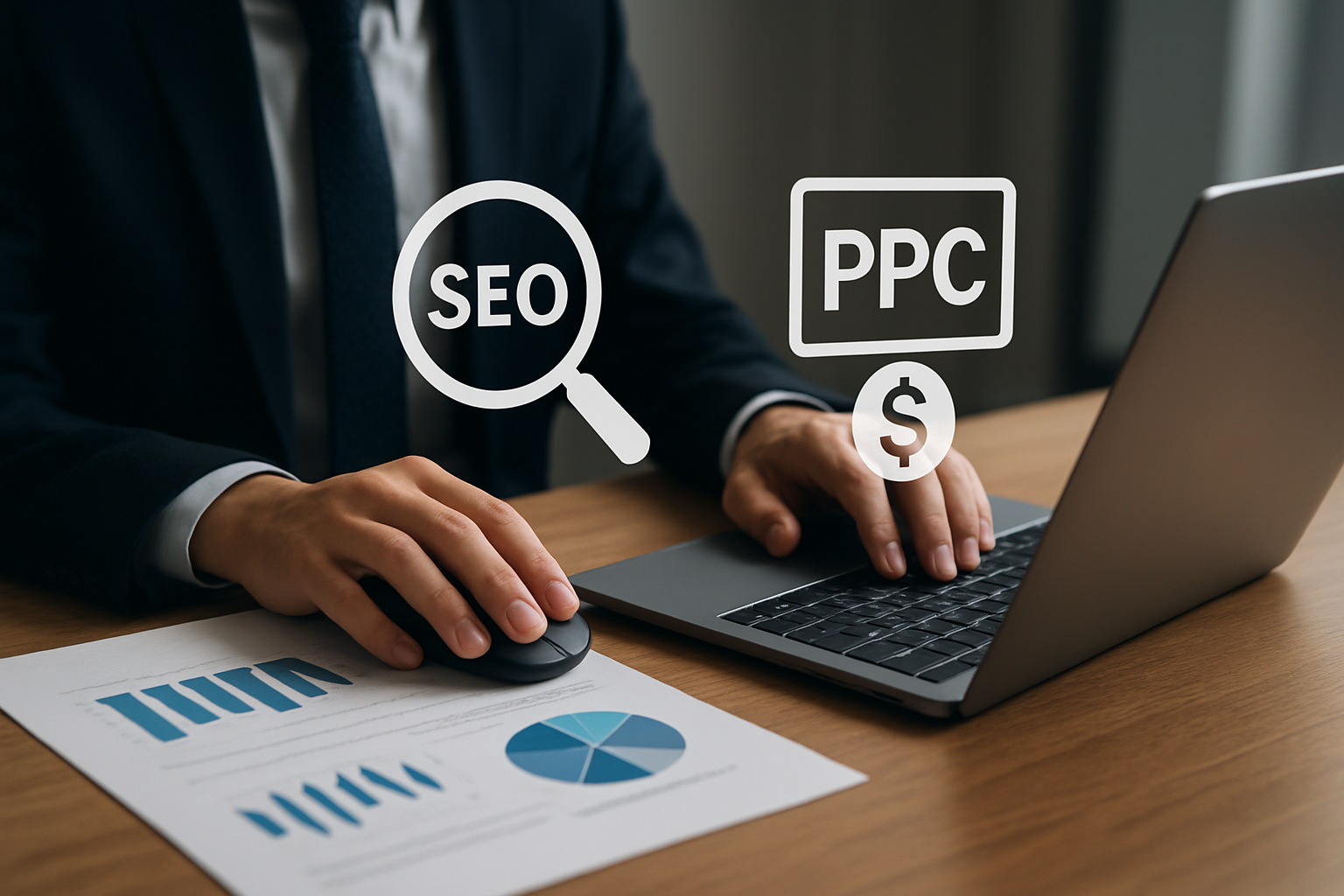
What it is: Integration means sharing keyword insights, unifying messaging on the search engine results page (SERP) [search engine results page], and coordinating offers across paid and organic channels. It also includes feedback loops from SEO (search engine optimization) content and site UX (user experience) [user experience] to paid landing pages.
Why it matters: Paid and organic elevate each other. When your brand appears twice on a SERP (search engine results page), click-through rates (CTR) [click-through rate] and conversion rates climb. Many brands observe 10 to 20 percent CPC (cost per click) reductions when high-quality scores meet strong SEO (search engine optimization) signals.
Quick example: Internetzone I mapped high-intent paid keywords to National & Local SEO (search engine optimization) content and refreshed meta titles while aligning offers in ads and on-site. Result: higher Quality Scores, lower CPC (cost per click), and more conversions with the same spend.
#6 What Is Your Strategy for Landing Pages, Speed, and Mobile Experience?
What it is: Landing pages should load quickly, match the intent of the ad, and make it effortless to convert. This includes mobile-responsive web design, clear call to action (CTA) [call to action], trust badges, and minimal form fields. For eCommerce (electronic commerce), it also means faster checkout, guest options, and up-front shipping clarity.
Why it matters: A one-second delay can reduce conversions by 7 percent, and most paid traffic is now mobile. Without purpose-built pages, you are paying for clicks that cannot convert. Agencies that build or guide landing pages typically deliver better CPA (cost per acquisition) and ROAS (return on ad spend).
Quick example: Internetzone I redesigned a franchise locator page with sticky call buttons, social proof, and local service areas. Calls from paid traffic increased 2.1 times and CPA (cost per acquisition) improved 29 percent within a month.
#7 How Do You Track Conversions and Ensure Data Accuracy?
What it is: Accurate tracking means setting up Google Analytics 4 (GA4) [Google Analytics 4], platform conversions, offline import, and call tracking, and using consistent urchin tracking module (UTM) [urchin tracking module] parameters. It also involves server-side tagging where appropriate, plus integrations with your CRM (customer relationship management) to connect marketing qualified leads (MQL) [marketing qualified lead] to revenue.
Why it matters: If conversions are missing or mislabeled, algorithms optimize to the wrong signals. Good data improves bidding, targeting, and creative decisions. Brands with clean event taxonomy often report 15 to 25 percent better ROAS (return on ad spend) simply by giving the system the right feedback.
| Metric | Definition | Formula | Why It Matters |
|---|---|---|---|
| CTR (click-through rate) | Share of impressions that become clicks | Clicks ÷ Impressions | Signals ad relevance; affects cost per click (CPC) [cost per click] |
| CVR (conversion rate) [conversion rate] | Share of clicks that convert | Conversions ÷ Clicks | Shows landing page and offer effectiveness |
| CPA (cost per acquisition) | Average cost to acquire a customer or lead | Spend ÷ Conversions | Core efficiency metric for budget decisions |
| ROAS (return on ad spend) | Revenue returned for every dollar spent | Revenue ÷ Spend | Key profitability indicator for scaling |
Quick example: Internetzone I implemented server-side tagging and standardized UTM (urchin tracking module) parameters for a software as a service (SaaS) [software as a service] client. Once GA4 (Google Analytics 4) and CRM (customer relationship management) revenue synced, Target CPA (cost per acquisition) bidding stabilized and ROAS (return on ad spend) rose 21 percent.
#8 How Will You Handle Budgets, Pacing, and Bid Strategies?
What it is: Budget pacing ensures you do not overspend early or stall late in the month. Bid strategies include Manual CPC (cost per click) [cost per click], Target CPA (cost per acquisition) [cost per acquisition], and Target ROAS (return on ad spend) [return on ad spend]. Ask how the agency switches strategies as data matures and how they prevent cannibalization across campaigns.
Why it matters: Smart pacing protects cash flow while maximizing volume. Meanwhile, choosing the right bid strategy at the right time accelerates learning without sacrificing control. For newer accounts, Manual CPC (cost per click) can be wise, then automated bidding once conversion volume is stable.
Quick example: Internetzone I ramped a new account with Manual CPC (cost per click) for two weeks to gather clean data, then moved to Target CPA (cost per acquisition). Spend became more efficient and CPA (cost per acquisition) fell 18 percent in the first month.
#9 What Is Your Testing Roadmap and Learning Cadence?

What it is: A testing roadmap outlines what will be tested, when, and how winners will be implemented. Common tests include headlines, images, offers, audience segments, and landing page layouts. It should also define sample sizes and run times to reach statistical confidence.
Why it matters: Consistent, disciplined testing compounds gains. Many brands get 5 to 15 percent lift each cycle from creative and landing page learnings alone. The key is to test one primary variable at a time and roll winners into evergreen assets quickly.
Quick example: Internetzone I uses a two-week sprint process for creative and a four-week cycle for landing pages. By sequencing tests and avoiding overlap, a business-to-business client captured a 32 percent conversion lift in six weeks.
#10 What Does Reporting Look Like, and How Often Will We Meet?
What it is: Reporting should combine dashboards with insights and actions. Ask for weekly highlights, monthly business reviews, and a shared roadmap. Clarify the service-level agreement (SLA) [service-level agreement] for response times, plus how ad-hoc questions are handled. If you use a tool like Looker Studio, confirm ownership of the data connectors.
Why it matters: You need visibility to make decisions and advocate internally. Great reports tell a story: what happened, why it happened, and what we will do next. They should also map back to your KPI (key performance indicator) targets and budget plans.
Quick example: At Internetzone I, clients receive weekly pulse updates, a monthly review covering wins and next actions, and a quarterly strategy sync. Our managed web services team also flags site issues that could impact paid performance.
#11 Who Will Work on My Account, and What Certifications Do They Hold?
What it is: You should meet your day-to-day team and know their experience across your industry and platforms. Confirm certifications such as Google Ads and Microsoft Advertising, and ask about copywriting, analytics, and web development support when needed.
Why it matters: Performance comes down to people, process, and platform. A senior strategist can spot issues early, while certified specialists execute with precision. Access to web design and development talent makes testing faster and higher quality.
Quick example: Internetzone I pairs an account strategist with a data analyst and a conversion-focused web designer. Our AdWords‑certified PPC (pay-per-click) Services team collaborates with SEO (search engine optimization) and reputation management to deliver full-funnel impact.
How to Choose the Right Option
Start by ranking your must-haves: target CPA (cost per acquisition) or ROAS (return on ad spend), timeline, budget, reporting cadence, and collaboration with SEO (search engine optimization) or web design. Then score each agency on four dimensions: strategy clarity, tracking rigor, creative and landing page capability, and communication. If an agency cannot explain its approach in plain language, that is a red flag.
Finally, validate with a pilot. Define success criteria and a 60- to 90-day plan, including specific tests and milestones. Keep the scope tight, the tracking airtight, and the learning agenda ambitious. The goal is not perfection; it is to prove fit and momentum quickly.
Your Next Step to a High-Performing PPC (pay-per-click) Strategy
Ask sharper questions, get clearer answers, and hire a partner who turns clicks into customers. That is the whole point of this guide.
Imagine the next 12 months with clean data, fast pages, and search engine optimization (SEO)-backed ads that compound gains every quarter. Your budget fuels a reliable flywheel instead of a stop-and-go experiment.
Which question will you put first in your interviews this week to ensure you choose a pay-per-click advertising agency that earns your trust and your budget?
Amplify PPC (pay-per-click) Wins with Internetzone I
Internetzone I blends National & Local SEO (search engine optimization) with AdWords‑certified PPC (pay-per-click) management to grow visibility, reputation, and conversions for companies of all sizes.