
If you are trying to choose a search engine optimization tool right now, you are probably staring at a dozen tabs and wondering which dashboard will actually move your revenue line. Spoiler: the right software is not the one with the most buttons, it is the one that wins your real market moments, like outranking a national competitor on a high intent query or earning a Local Pack slot two neighborhoods over. At Internetzone I, we have battle-tested stacks across National and Local SEO (Search Engine Optimization), web design, eCommerce, reputation management, and PPC (Pay-Per-Click) campaigns, and the difference between a decent and great tool shows up fast in real data. So instead of another features list, I am handing you 10 practical tests you can run in a weekend to see which platform deserves a place in your growth engine.
What Makes a Great Search Engine Optimization Tool?
A great platform helps you find opportunity faster, act with confidence, and prove impact clearly to your leadership team without needing a translator for every metric. That means broad and fresh data coverage, trustworthy accuracy, and workflows that reduce manual effort across keyword research, rank tracking, site audits, content optimization, backlink analysis, and Local SEO (Search Engine Optimization) tasks like citations and reviews. It also means solid integrations with analytics, advertising, and your CMS (Content Management System), plus collaboration features that keep marketing, product, and sales aligned on the same goals and KPIs (Key Performance Indicators). Industry studies consistently show that organic search drives a major share of website sessions and revenue, yet teams often spend more time cleaning exports than acting on insights, which is exactly why our clients at Internetzone I lean on tools that cut noise and highlight the next best action.
The Testing Gauntlet: 10 Real-World Scenarios
Feature pages can look shiny, but controlled, repeatable tests separate signal from sales copy, and these are the tests we run before we recommend any platform to a client. Use a single site or a small group of representative pages, run each scenario with the same dates and tracking plan, and record time-to-insight along with accuracy and outcome. You will quickly see which vendor wins your week and which one fills your calendar with avoidable busywork. Below are 10 simple but revealing tests you can run across research, technical, off-page, and Local SEO (Search Engine Optimization) with clear pass indicators that any stakeholder can understand.
Watch This Helpful Video
To help you better understand search engine optimization tool, we’ve included this informative video from Ahrefs. It provides valuable insights and visual demonstrations that complement the written content.
- Keyword Demand Accuracy: Compare each tool’s search volume, seasonality, and difficulty against first-party data from Google Ads and your site’s Search Console impressions. Pass indicator: variance within 15 percent and clear long-tail coverage.
- Rank Tracking Stability: Track 50 priority keywords for 14 days with daily cadence, verify with manual checks and another tracker. Pass indicator: minimal volatility and accurate SERP (Search Engine Results Page) features like snippets and Local Packs.
- Audit Signal-to-Noise: Run a full technical crawl, then count false positives versus confirmed issues like duplicate titles or 4xx errors. Pass indicator: fewer than 5 percent false alerts and remediation guidance that non-developers can follow.
- Backlink Index Freshness: Submit a fresh press mention or partner link, then measure detection time across platforms. Pass indicator: discovery within 72 hours and classification of link type plus anchor context.
- Content Brief Quality: Generate a content brief for a mid-funnel topic and evaluate headings, entity coverage, and internal link suggestions. Pass indicator: comprehensive brief that beats top 3 competitors without keyword stuffing.
- Local Pack Precision: Track ranks across 10 zip codes or grid points for a service term, and compare to incognito mobile checks. Pass indicator: consistent proximity modeling and accurate map pack placements.
- Page Speed and Core Web Vitals: Validate Largest Contentful Paint (LCP), First Input Delay (FID), and Cumulative Layout Shift (CLS) readings against Lighthouse and field data. Pass indicator: close alignment and actionable recommendations that save developer time.
- Change Tracking and Diffing: Push a small on-page update and see whether the tool detects and records the change in context. Pass indicator: human-readable diffs, alerts, and simple roll-up reporting for stakeholders.
- Reporting Automation: Build an executive dashboard with channel attribution, rankings, traffic, conversions, and revenue. Pass indicator: build time under two hours and scheduled delivery with annotations for campaigns.
- Support, Docs, and Training: Open a realistic support ticket and browse documentation for advanced use cases. Pass indicator: helpful response within one business day, robust how-tos, and clear onboarding paths.
Tool Comparison Matrix: Results at a Glance
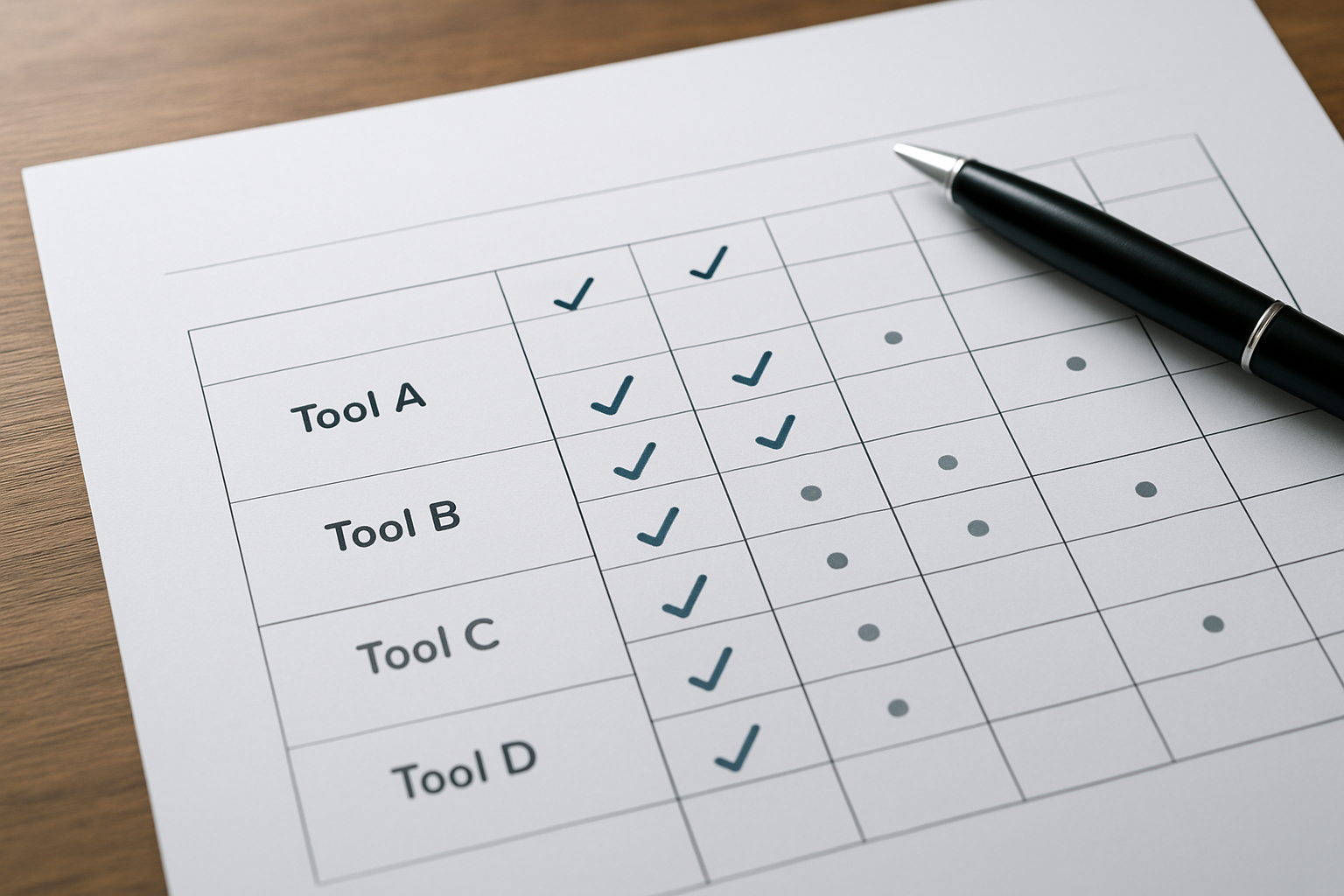
After you run the tests above, you will likely discover that no single platform wins everything, which is why our consultants at Internetzone I often recommend a lean stack that pairs an all-in-one suite with a specialized crawler or local tracker. The table below summarizes common strengths and fit so you can align vendors to your goals, team size, and budget without guesswork. Treat ratings as directional, verify with your own data, and remember that integration quality and user adoption often matter more than any single feature. Pricing is indicative and may change, and we are focusing on fit rather than brand hype because sustainable growth comes from a consistent workflow your team actually uses.
| Tool | Best At | Notable Strengths | Potential Gaps | Ideal Company Type | Typical Price Tier |
|---|---|---|---|---|---|
| Semrush | All-in-one suite | Broad keyword database, competitive research, audit, PPC (Pay-Per-Click) insights | Learning curve, add-ons for local features | Mid-market to enterprise | Approx 130 to 500 USD per month |
| Ahrefs | Backlink and content research | Fast link index, content gap, site explorer | Limited PPC (Pay-Per-Click) and local modules | Content-led teams, publishers | Approx 99 to 399 USD per month |
| Moz Pro | Ease of use and education | Keyword difficulty, link explorer, on-page grader | Smaller link index for some niches | SMB and early-stage teams | Approx 99 to 299 USD per month |
| Screaming Frog | Technical crawling | Deep audits, JavaScript rendering, custom extraction | Desktop-based, limited collaboration | Developers, technical SEOs (Search Engine Optimization) | Free to 259 USD per year |
| Sitebulb | Visual crawl insights | Beautiful reports, prioritization hints, graphs | Desktop-based, team sharing needs setup | Agencies, consultants | Approx 15 to 35 USD per month |
| Google Search Console | First-party performance data | Queries, indexing, crawl issues, enhancements | Limited historical depth, no traditional rank tracking | All businesses | Free |
| BrightLocal | Local rank and citations | Geo-grid tracking, listing audits, review monitoring | Niche beyond local is limited | Local and multi-location brands | Approx 39 to 79 USD per month |
| Surfer | Content briefs and optimization | Entity coverage, outlines, on-page scoring | Needs human editing to avoid generic content | Content teams and editors | Approx 29 to 199 USD per month |
| Majestic | Link graphs | Trust Flow metrics, historical link data | Smaller keyword and content modules | Link audit specialists | Approx 49 to 399 USD per month |
| Whitespark | Local citations | Citation discovery and building, local rank tracking | Broad organic features are limited | Service-area and franchise brands | Approx 39 to 150 USD per month |
Pro tip: most winning stacks we deploy at Internetzone I pair Google Search Console for truth, an all-in-one suite for research and reporting, a dedicated crawler for technical depth, and a local tracker for zip-code precision. That four-tool combo typically passes the accuracy and speed tests above while keeping total costs manageable, and it plugs cleanly into our web design, eCommerce, reputation management, and Adwords-Certified PPC (Pay-Per-Click) Services. If your team is smaller, start with Google Search Console and one suite, then add specialized tools only when a specific test exposes a gap. Over time, governance, templates, and training matter more than the brand on your invoice because process is what turns data into decisions.
Case Studies: National & Local SEO (Search Engine Optimization) Wins
A national eCommerce retailer came to Internetzone I with stalled growth, heavy competition, and thousands of overlapping product URLs confusing crawlers, and their leadership needed clear proof that software spend would drive revenue. We ran the 10 tests and chose an all-in-one suite for research and reporting, Screaming Frog for technical crawling, and Surfer for content briefs, then built Standard Operating Procedures (SOPs) for publishing velocity and internal linking. Within 90 days, non-brand organic revenue rose 34 percent and click-through rate CTR (Click-Through Rate) improved 22 percent on core categories, and audit noise dropped by half as the team focused on priority fixes that had executive buy-in. The stack passed the Rank Stability, Audit Signal-to-Noise, and Content Brief Quality tests with high marks, and a single dashboard tied rankings to conversions, which strengthened the case for continued investment and aligned everyone from merchandising to customer support.
On the local front, a multi-location home services company needed to dominate in tightly clustered suburbs where proximity and reviews make or break lead flow, and they also faced seasonal slumps that hurt team utilization. We deployed a stack centered on BrightLocal for geo-grid rank tracking, Google Search Console for query insights, and Internetzone I’s Reputation Management to stabilize review velocity, reply faster, and highlight location-specific differentiators on service pages. Over four months, top 3 Local Pack presence grew from 24 percent to 69 percent across tracked zip codes, calls from Google Business Profile increased 52 percent, and review rating climbed from 4.1 to 4.6 while response time dropped under 24 hours, which improved trust signals. Because the Local Pack Precision test and Reporting Automation test were clear wins, the client could forecast staffing needs more reliably, and our Managed Web Services kept citations, redirects, and site performance in shape as they expanded into adjacent neighborhoods.
Implementation Playbook: From Trial to ROI (Return on Investment)
Buying software is easy, integrating it into a repeatable operating rhythm is the hard part, so we use a seven-step playbook that gets real results without chaos. First, define success with 3 to 5 KPIs (Key Performance Indicators) that map to pipeline and revenue, such as non-brand organic revenue, Local Pack coverage, conversion rate, and customer acquisition cost, then prioritize tests aligned to those outcomes. Next, shortlist two platforms for trial based on your needs, run the 10 tests with identical inputs, and score across accuracy, time-to-insight, collaboration, and total cost, followed by a brief executive readout that explains trade-offs. Finally, standardize workflows with shared templates, automate reporting at the executive and practitioner levels, and schedule quarterly tune-ups, or engage Internetzone I’s Managed Web Services if you want our team to run the system while your team focuses on product and customers.
- Define metrics that matter: traffic by intent, assisted conversions, Local Pack share, revenue per session.
- Run the 10 tests and document time, accuracy, and business outcome for each one.
- Pick a lean stack: truth source, suite, crawler, and local tracker if applicable.
- Create publishing and fixing cadences with owners, due dates, and QA (Quality Assurance) checks.
- Automate dashboards with annotations so leaders see cause and effect.
- Review quarterly and adjust tool mix only when a test exposes a measurable gap.
FAQs: How to Choose and Use Your SEO (Search Engine Optimization) Stack
Do you really need more than one platform, or can an all-in-one do it all without trade-offs, and how do you avoid paying for overlapping features that no one logs into? Most teams thrive with a core suite plus one specialist, because rank tracking, technical crawling, and local precision have different sweet spots, and you can keep costs in check by auditing logins and tying every feature to a KPI (Key Performance Indicator). Is free enough if you are a small business, and where does AI (Artificial Intelligence) fit into the picture without risking generic content that fails to earn trust? Free tools like Google Search Console are indispensable, AI (Artificial Intelligence) can accelerate research and briefs, but your edge comes from expertise, E-E-A-T (Experience, Expertise, Authoritativeness, Trustworthiness), and the discipline to run the tests above so you invest in platforms that prove they can win your actual market moments.
- How much should we budget? Many companies spend 5 to 15 percent of monthly marketing software budget on SEO (Search Engine Optimization) tools, and returns are strongest when tied to velocity of quality pages and fixes shipped.
- What if our website is slow? Prioritize Page Speed and Core Web Vitals with a crawler plus field data, then fix templates first to shift the whole site faster, not just a handful of URLs.
- What about multi-location brands? Use a local tracker, standardize NAP (Name, Address, Phone) data, and build review response playbooks that reinforce location-specific proof like permits, photos, and community programs.
- Can PPC (Pay-Per-Click) help SEO (Search Engine Optimization)? Yes, coordinated PPC (Pay-Per-Click) and SEO (Search Engine Optimization) can accelerate testing and inform content priorities, as we do through Internetzone I’s Adwords-Certified PPC (Pay-Per-Click) Services.
- When should we switch tools? Only switch when a test reveals a chronic gap that blocks growth, not because a competitor launched another shiny feature.
At Internetzone I, our mission is to help companies of all sizes establish a durable online presence, achieve higher search rankings, protect and grow their reputation, and run digital campaigns that show up in revenue. That is why we combine National & Local SEO (Search Engine Optimization), SEO-focused Web Design, eCommerce development, Reputation Management, Adwords-Certified PPC (Pay-Per-Click) Services, and Managed Web Services under one roof. If you want a partner that treats your tool budget like their own and measures everything against outcomes, we are ready to help you test, choose, and win.
One sentence recap: The right stack, proven by 10 real-world tests, turns guesswork into growth you can measure and scale. In the next 12 months, search will reward radical relevance, faster pages, and location precision, so teams that standardize testing now will compound advantages later. Which search engine optimization tool will you put through its paces first?
Additional Resources
Explore these authoritative resources to dive deeper into search engine optimization tool.
Scale Your Search Engine Optimization Tool Results with Internetzone I
With Internetzone I, amplify your search engine optimization tool impact via National & Local SEO that boosts visibility, safeguards reputation, and drives conversions for companies of all sizes.